
On supporting science journalism
If you're enjoying this article, consider supporting our award-winning journalism by subscribing. By purchasing a subscription you are helping to ensure the future of impactful stories about the discoveries and ideas shaping our world today.
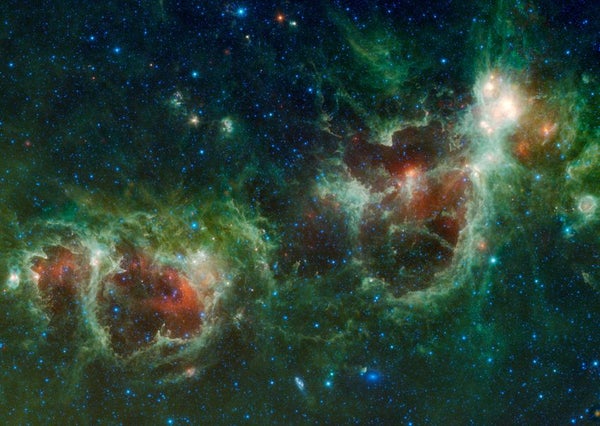
MIAMI—A satellite launched by NASA in 2009 to map the entire sky in the infrared is capturing some pretty pictures along the way. Scientists from the WISE mission, short for Wide-field Infrared Survey Explorer, released this image of the so-called Heart and Soul nebulae Monday at the semiannual meeting of the American Astronomical Society being held here this week.
The nebulae have "the romantic official names IC 1848 and IC 1805," joked WISE's principal investigator Edward Wright, an astronomer at the University of California, Los Angeles. But the more florid appellation Heart and Soul comes from their appearance. "They both look like hearts," Wright said. "One looks like a Valentine's Day heart, and one looks like a surgical heart that you have in your body." The anatomical heart (the Soul Nebula, or IC 1848) is on the left in this image, whereas the sideways heart symbol (the Heart Nebula, or IC 1805) is on the right.
Wright noted that the composite photo from WISE, cobbled together from 1,147 individual images, covers an area he investigated as a graduate student in the 1970s. The difference is that WISE images have a million times more pixels than those taken with the balloon-borne detector he used back then. "I have gone in my career from an observatory with four pixels to an observatory with four million pixels at a time," he said.