
Space & PhysicsMay 3, 2010
Southern Hemisphere's Largest Telescope Hamstrung by Optical Problems
As South Africa angles for a massive telescope project, its own SALT telescope has been offline for a year
Southern Hemisphere's Largest Telescope Hamstrung by Optical Problems
As South Africa angles for a massive telescope project, its own SALT telescope has been offline for a year
Star physicists trade barbs over cosmological model

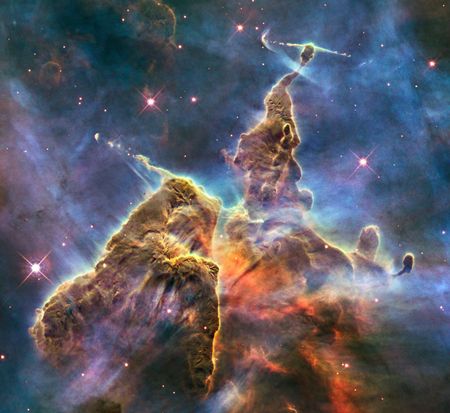
New view of dusty spires marks Hubble's 20th birthday
The Hubble Space Telescope passed its 20th anniversary of reaching orbit on April 24, an occasion marked with the release of a new image from the venerable observatory, depicting a star-forming region of the Milky Way some 7,500 light-years away called the Carina Nebula.
Hubble Space Telescope clocks up 20 years
looks at a troubled history, some remarkable discoveries and the future of the instrument.
Novel Experiment Prepares to Join Dark Energy Hunt
By retrofitting a Texas telescope with a low-cost, modular instrument, researchers hope to find clues to what is driving the accelerating expansion of our universe
What's the (dark) matter? Physicist Peter Fisher says we may not know for 10 years
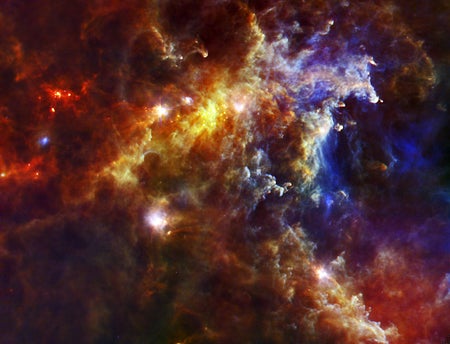
Herschel space observatory peers into stellar nursery
Protostars shine in their dusty shrouds in this image of the molecular cloud associated with the Rosette Nebula from the European Space Agency's Herschel spacecraft .
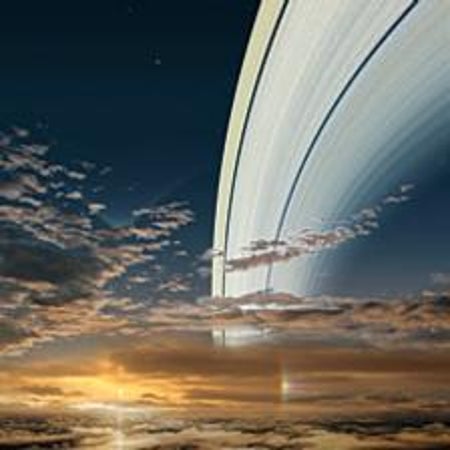
8 Wonders of the Solar System
Artist Ron Miller takes us on a journey to eight of the most breathtaking views that await intrepid explorers of our solar system. The scale of these natural wonders dwarfs anything Earth has to offer. What might we see and feel if we could travel to these distant domains? The artist's eye—interpreting data from probes such as NASA's Cassini, which is now exploring the Saturnian system, and MESSENGER, which has flown by Mercury three times and goes into permanent orbit next March—allows us an early visit to these unforgettable locales.
6 Fun Facts about the James Webb Space Telescope [Slide Show]
The mammoth infrared observatory, scheduled to launch in 2014, will look back to the first stars in the universe
Volunteer army catches interstellar dust grains
Stardust mission finds particles that represent the building blocks of the solar system.
Dark Side of Black Holes: Dark Matter Could Explain the Early Universe's Giant Black Holes
Massive black holes should not have existed in a universe less than one billion years old, yet they did
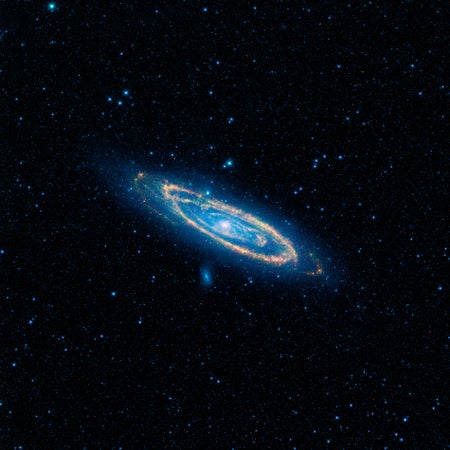
WISE gives Milky Way's closest sibling a new look
The Andromeda Galaxy, a spiral galaxy 2.5 million light-years away, is something of a big sister to our own Milky Way.