February 18, 2010
1 min read
 Add Us On GoogleAdd SciAm
WISE gives Milky Way's closest sibling a new look
The Andromeda Galaxy, a spiral galaxy 2.5 million light-years away, is something of a big sister to our own Milky Way.
On supporting science journalism
If you're enjoying this article, consider supporting our award-winning journalism by subscribing. By purchasing a subscription you are helping to ensure the future of impactful stories about the discoveries and ideas shaping our world today.
The Andromeda Galaxy, a spiral galaxy 2.5 million light-years away, is something of a big sister to our own Milky Way. Andromeda contains roughly a trillion stars, a few times more than the Milky Way, but as the nearest major galaxy and the nearest spiral, it is useful for studying the structure of galaxies like our own. (Since astronomers are deeply embedded in the Milky Way, it is difficult to make comprehensive measurements of our home universe.)
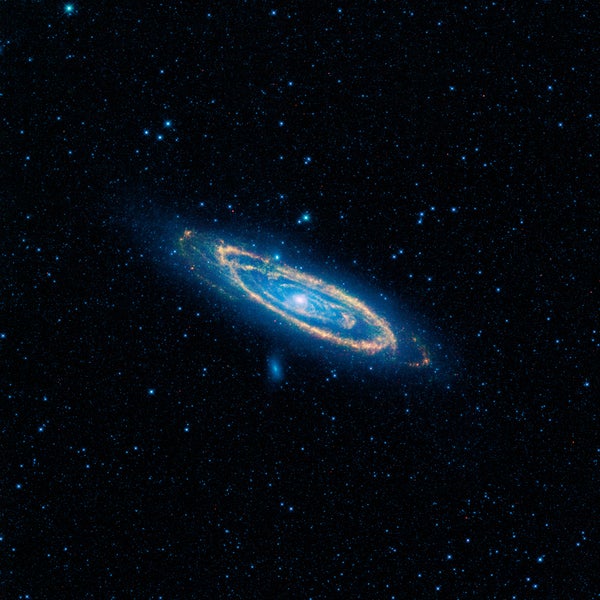
NASA launched the Wide-field Infrared Survey Explorer, or WISE, in December to map the sky in infrared wavelengths. The spacecraft has already discovered a new asteroid and comet near Earth, and on Wednesday the space agency released a series of images WISE has captured of known astronomical objects. In this infrared image of Andromeda, bluer light represents stars, which give off a great deal of heat, whereas redder hues mark cooler regions, such as dusty wisps within the galaxy. The blue lobe below the galactic disk is Messier 110, an elliptical galaxy that is one of Andromeda's many satellites.
Subscribe to Support Independent Journalism
Great science journalism requires human expertise, time, effort and creativity. And it costs money. That’s why I and the journalists here at Scientific American hope you’ll join our community.
When you subscribe, you are supporting staff and freelance journalists who are passionate about telling science stories that are true, important and compelling. Our editors and reporters are often experts in their fields, which means they understand the nuances of big discoveries and can untangle the breakthroughs from the hype. With a subscription, you are also supporting rigorous fact-checking to ensure the words we publish are precise and accurate. And you’re supporting original illustrations, graphics and photos that bring you closer to an advanced laboratory, an ice sheet in Antarctica or a space mission in orbit. You’re helping us craft other types of high-quality journalism as well: Our newsletters are carefully written, edited and curated by staffers you have or will come to know and love. Our Science Quickly podcast is based on original reporting, collaboration with editors and scientists and exacting production.
Subscriptions keep this engine running so we can continue to deliver thoughtful, rigorous and independent science journalism to you. In an era of viral misinformation, this work is crucial. If you value what we do, I hope you’ll consider joining us as a subscriber