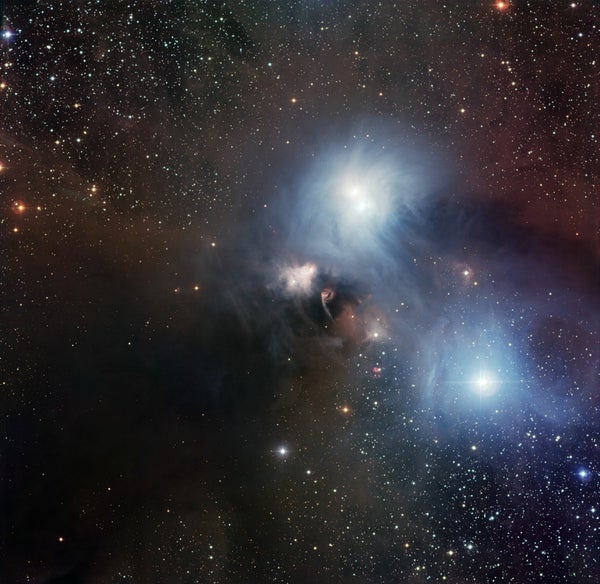
Wispy cloud illuminated by young stars in Corona Australis
This view from the European Southern Observatory's La Silla Paranal Observatory in Chile shows a nearby star-forming region, some 500 light-years away, in the constellation Corona Australis (the Southern Crown).
On supporting science journalism
If you're enjoying this article, consider supporting our award-winning journalism by subscribing. By purchasing a subscription you are helping to ensure the future of impactful stories about the discoveries and ideas shaping our world today.
This view from the European Southern Observatory's La Silla Paranal Observatory in Chile shows a nearby star-forming region, some 500 light-years away, in the constellation Corona Australis (the Southern Crown). The La Silla portrait is a composite of 12 color-filtered images of 67 megapixels apiece.
Newly formed stars shine from within the massive, wispy cloud of dust in which they formed. Near the center of the image is the star R Coronae Australis, which marks the most active area of star production in the cloud. In the lower left of the image the so-called dark cloud is so opaque that it blots out the background light from more distant stars and galaxies.
It’s Time to Stand Up for Science
If you enjoyed this article, I’d like to ask for your support. Scientific American has served as an advocate for science and industry for 180 years, and right now may be the most critical moment in that two-century history.
SciAm always educates and delights me, and inspires a sense of awe for our vast, beautiful universe. I hope it does that for you, too.
If you subscribe to Scientific American, you help ensure that our coverage is centered on meaningful research and discovery; that we have the resources to report on the decisions that threaten labs across the U.S.; and that we support both budding and working scientists at a time when the value of science itself too often goes unrecognized.
In return, you get essential news, captivating podcasts, brilliant infographics, can't-miss newsletters, must-watch videos, challenging games, and the science world's best writing and reporting. You can even gift someone a subscription.
There has never been a more important time for us to stand up and show why science matters. I hope you’ll support us in that mission.