

Rachel Feltman: For Scientific American’s Science Quickly, I’m Rachel Feltman.
The abstract concepts and complex equations found in the study of physics can feel as esoteric as they do intimidating. But today’s guest believes that physics can actually be deeply poetic, philosophical and even political.
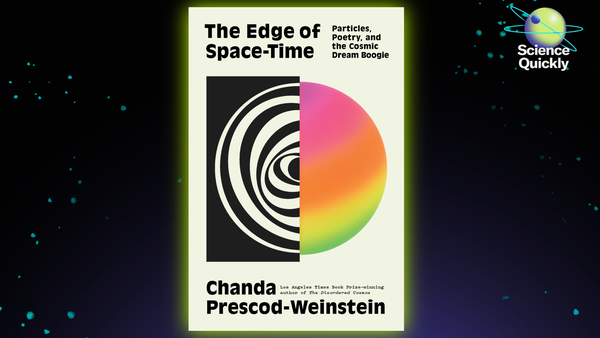
Theoretical physicist Chanda Prescod-Weinstein’s new book, The Edge of Space-Time: Particles, Poetry, and the Cosmic Dream Boogie, weaves together cosmology, quantum mechanics, history, queer theory and pop culture—from Star Trek to Missy Elliott—to bring readers on a mind-altering journey to the boundaries of the universe. By exploring the edges of what we know about spacetime, she argues, we can gain a new perspective on the limitless possibilities of our own existence.
On supporting science journalism
If you're enjoying this article, consider supporting our award-winning journalism by subscribing. By purchasing a subscription you are helping to ensure the future of impactful stories about the discoveries and ideas shaping our world today.
Chanda recently came by the office to chat with SciAm associate books editor Bri Kane. Here’s their conversation.
Bri Kane: I am so excited to talk to you about all of my biggest and weirdest physics questions today [Laughs], but I wanted to start off with the poetry that you talk about in this book. You say that when physics is at its best, it’s very poetic. How is physics poetic to you?
Chanda Prescod-Weinstein: I mean, I think the universe is poetic. There’s something really beautiful and elegant, particularly for me, as a theoretical physicist, how all the pieces come together. There’s a poetry to that. There’s a rhythm to it and—rhythm and patterns, right? So I think what we do in physics is look for patterns and try and establish patterns. And poetry is often very pattern-based, whether you’re talking about meter or the structure of the poem on the page. So I see a lot of links.
Kane: Yeah, I mean, this book really connects a lot of different subjects in science and then brings them all to the center in physics. But one that I thought was really interesting is there’s a lot of history in this book and a lot of history that I didn’t know about. [Laughs.] There’s a lot of people that you talk about as being the first in their field or newly realized as the first in their field. And so I wanted to ask you about Mozi from the Zhou kingdom.
Prescod-Weinstein: So I should start by saying I didn’t come into the book thinking, “I’m gonna write about Zhou kingdom philosophers from, you know, before China was established,” and so even figuring out, “How do I talk about this?” because the reference point is going to be—this is stuff that’s written in ancient Chinese.
And as I was writing about Newton’s laws and trying to figure out, “How do I make Newton’s laws interesting to me?” ’cause I actually hated frosh physics. I did not enjoy it. It wasn’t my jam. I was someone who was, like, really hype about quantum mechanics, quantum physics, general relativity, that kind of thing. And in doing some research I saw a little note somewhere that actually this philosopher from the Zhou kingdom, Mozi, had come up with one of Newton’s laws, like, a millennium before Newton had.
And so I chased this down, and it was a real moment of synergy of understanding how much we in the sciences depend on the humanities because someone had taken the time to do the translation. And it just opened this whole world to me of people asking these questions about “How do I explain the difference between extent in space and duration in time?” and the different ways that these people who lived very close to the land and in a different way were trying to have these conversations with themselves about the difference between space and time, or maybe the lack of difference between space and time.
Kane: Yeah, I mean, as you say in the book, we have been looking to the stars since there were stars, since we were able to look at them. I mean, it’s something that has always inspired us and also helped us reflect on ourselves, which I thought was really interesting ’cause physics can be kind of intimidating to people as a field, but it’s also very philosophical and poetic, as you’re saying, and it can be really exciting. It can also be pretty funny. I mean, I laughed out loud at a few lines in this book, and, and physics does not normally ...
Prescod-Weinstein: Nailed it!
Kane: Make me laugh, I have to say. [Laughs.]
Prescod-Weinstein: [Laughs.]
Kane: But I mean, you open the book with a Star Trek quote, and I counted at least four Star Trek generations and one Star Trek movie, the whale one. So I wanted to ask you about Star Trek inspiring your interest in physics and what in Star Trek do you think is the most interesting physics conundrum they kind of play with?
Prescod-Weinstein: So I will say that I hate time-travel stories usually. I struggle with them because it’s hard to make them logical. The time loops are always really difficult. Actually, one of the Star Trek films that I really love that I don’t talk about in the book is Star Trek: First Contact.
Kane: Mm.
Prescod-Weinstein: And that one is a time-travel film that involves, basically, these socialist utopians from the future going into the past to make sure that their socialist utopian future happens.
Kane: Mm-hmm.
Prescod-Weinstein: And I think that that’s politically a really interesting film. It’s a film that engages a lot with one of my favorite novels, Moby-Dick. I’m completely obsessed with Moby-Dick.
That one film actually highlights for me a lot of the power of Star Trek, which is, it’s about our relationships with each other, about how we envision who we are going to be to each other in the future.
So I think a lot of people think of it as, like, “Oh, that’s science fiction. It’s about technology. It’s about, what, traveling faster than the speed of light, which I don’t think is ever gonna happen.” So I think in a lot of ways that’s, like, the least interesting thing about the film and the franchise.
I think the most interesting thing is the way that they organize science being done and that humans have transformed ourselves into a species of peaceful, curious people who go out into the cosmos, make sure that everybody’s basic needs are taken care of, make sure that we have ways of interacting with species that are new to us that are respectful and honor our values while also honoring the values that may be new to us.
And for me that’s really a guiding way of thinking about, if I am going to ask questions of what science as a community should be, that I think Star Trek is, for me, my guiding light in thinking about, “How do I want scientists to be with each other, and how do I want scientists to be in society?” And I think that Star Trek does a good job of representing that society that I want to be in.
Kane: Yeah, I mean, you talk about a few specific Star Trek episodes. Not to pivot too far away from Star Trek, ’cause I could stay here all day and just talk to you about that [Laughs], but you’ve said before that Vera C. Rubin has asked you about the dark matter problem. She asked you, “How do you think we should solve the dark matter problem?” One, congratulations on being able to speak with her—that’s incredible. But also, what is the problem, and have you solved it yet? [Laughs.]
Prescod-Weinstein: I was very lucky that I got to meet her at a Women in Astronomy conference in 2009. I was a graduate student—like, I didn’t realize Vera Rubin was even gonna be there. And then someone introduced me to her, and the very first thing she says to me is, “So how do you think we should solve the dark matter problem?” And at that point I was working on cosmic acceleration; that’s what my dissertation was about.
Kane: Mm-hmm.
Prescod-Weinstein: I had no prepared answer for that. And I was really sitting there, like, panicking. I have no idea what I said.
Whatever I said, she was super gracious about it, and I got the opportunity to spend more time. I had lunch with her, and we actually went to the White House together to talk about women and girls in astronomy in the first year of the first Obama administration. And the White House Council on Women and Girls and Tina Tchen had invited us to come talk to them about these issues. So that’s kind of the context for my experience in meeting with Vera Rubin.
As a postdoc I went on to start working on it, and I think one of the reasons that I felt like, “Okay, this is a problem I can tackle,” is that Vera Rubin had literally been part of the team, along with Kent Ford, that proved to the astronomy community that most of the normally gravitating matter in the universe is completely invisible to us—it’s what we call dark matter. And she had basically said, “This is a problem that’s open for you to think about. This is a problem that’s open for you to solve.” And so when the opportunity came around for me to start working on it, I started working on it partly because I needed something to do; I needed to get publications. But I think it felt open to me in a way because of that question that she had asked me.
I should hedge on whether we have figured out what dark matter is or not because it may be that there’s a publication sitting on the archive or in a journal right now that has the right model in it ...
Kane: Mm-hmm.
Prescod-Weinstein: And we haven’t proven that that’s the correct model. It could be that it’s the axion, which is the hypothetical particle that I work on and my research group works on.
Kane: Mm-hmm.
Prescod-Weinstein: I don’t know. We’re still waiting for data.
Some of the data that I think is gonna help us with this question is actually coming back from the Vera C. Rubin Observatory that is taking its first steps into observation right now. I think that that, paired with the Nancy Grace Roman Space Telescope, which is launching later this year, that we’re gonna get a lot of insight into galaxy structure.
And we know that dark matter dominates most galaxies. So the visible part of the galaxy is actually just a small fraction of the total matter and mass that’s there. And so we’re gonna be looking at all of this new galaxy data, also from the ESA’s Euclid telescope, to get a sense of how galaxies are really structured in more detail than we’ve ever seen before, and that’s very exciting. JWST is also contributing to that. The images from the Just Wonderful Space Telescope have been incredible. [Laughs.]
Kane: [Laughs.] Actually, I wanted to ask you about cosmic acceleration because you actually mention us in this book—January 1999 issue. There’s a graphic in here that you have in this book. It’s such a fascinating question in your field, too, because, not to dumb it down too much, but why is that happening, and why does it freak me out so much when I think about it? [Laughs.]
Prescod-Weinstein: So spacetime is expanding. We know this already. And this was something that had been known for decades. And then when I was finishing up high school in the late ’90s, two different groups making supernova observations and using supernovae as basically ways of measuring distance in the universe noticed that the numbers seemed to be indicating that the expansion was picking up speed, so cosmic acceleration is what we call it.
And we don’t know why. I guess it depends on who you ask, right? So I have friends who will say, “Well, it’s obviously just a cosmological constant. There’s a vacuum energy that is fundamental to the vacuum that is causing it to pick up speed. This works if you put it into [Albert] Einstein’s equations.” I find that to be a very unsatisfying answer. As you know I rant about this a little bit in the book. [Laughs.]
Kane: [Laughs.] I mean, anytime someone in science says, “Well, obviously, it’s this,” my hackles go up. I have some ...
Prescod-Weinstein: Yeah.
Kane: Follow-up questions immediately ’cause is it really that obvious? Has it been that obvious for that long? And this feels like one of those questions in your field ...
Prescod-Weinstein: Yeah.
Kane: That the answer isn’t obvious. We’re still wrestling with it. It, it might be this. We’re leaning towards a direction. But we haven’t fully decided yet.
Prescod-Weinstein: I do think this is a problem where, on paper, the people who are saying it’s just a cosmological constant could be right. The problem with that is then I need you to explain to me why the cosmological constant, that vacuum energy that’s associated with it—or dark energy, as this problem is often called—where does that come from?
So you can answer that question by saying that, actually, there are many different bubbles of spacetime, and we happen to be in the bubble that has the value that it has, and if it didn’t have the value that it has, we probably wouldn’t exist to observe it, which is—this is one version of what’s called the anthropic principle.
Kane: Yeah.
Prescod-Weinstein: Which is—the way—I tried to state it in a way that doesn’t make it sound like we’re at the center of the universe, like we’re just kind of incidental to this phenomenon and the entire thing is a coincidence.
Kane: Mm-hmm.
Prescod-Weinstein: But then what an odd coincidence. So this is known as the coincidence problem, right? [Laughs.]
Kane: [Laughs.]
Prescod-Weinstein: So even if you pick that solution, which is very mathematically simple, relatively speaking, it raises all kinds of questions that are not just physical but also metaphysical questions.
Kane: Yeah, I mean, it seems like physics overall and cosmology in your focus is by answering one question, you have now created 100 more [Laughs], and that’s part of the fun of it [Laughs] ...
Prescod-Weinstein: Yeah.
Kane: And that’s part of the adventure in the discovery of it there.
I mean, I have to say, I am not a physicist by training. I’ve learned more physics in these pages than any professional setting previously. But I have to say, I felt really grounded and I felt like I was really following someone who knew where we were going in this book. And one of the things that really helped me is all of these pop culture references.
I mean, I tried to count as many as I could, but there’s so many comparisons that you make to pop culture. I mean, we learn about symmetry through a Missy Elliott record, like, lyrics. We learn about the concept of spacetime with Sun Ra. I mean, we talk about Octavia Butler, Tracy K. Smith, Big K.R.I.T, Mos Def [now going by Yasiin Bey], Insane Clown Posse [Laughs], Lewis Carroll [Laughs], Stephen Hawking, Carl Sagan. The Drake and Kendrick [Lamar] battle comes up in this book. [Laughs.]
Prescod-Weinstein: Drake should have quit earlier.
Kane: [Laughs.]
Prescod-Weinstein: That’s all I’m gonna say about that.
Kane: What was your favorite reference to use when explaining these kind of thorny physics problems to those of us who haven’t spent our professional life studying the cosmos?
Prescod-Weinstein: So in a lot of ways this book was very vulnerable for me because it was welcoming people into my weird game-of-associations brain.
Kane: Yeah.
Prescod-Weinstein: And so it was interesting for me as I was writing to see what came up and what ideas came to me. And I think if I had to pick, like, a most-favorite one—in the chapter where I’m trying to explain quantum gravity, so trying to figure out how we put quantum mechanics into conversation with Einstein’s general relativity, I was trying to explain the idea of small extra dimensions. So beyond the three spatial dimensions we’re in, plus the one time dimension, that there are these ideas in quantum gravity where you add these small extra dimensions.
And the story that came to mind for me is one from Star Trek: Discovery with Anthony Rapp as the engineer [Paul] Stamets and Wilson Cruz as his husband, [Hugh] Culber.
Kane: Mm-hmm.
Prescod-Weinstein: And it is this beautiful queer love story that was almost quite disastrously, actually, like, another kind of trope of queer death. And luckily, some people talked some sense into the production writers’ room so that it doesn’t end that way.
But there is this moment where, spoiler alert, Culber is trapped in these small extra dimensions, and Wilson Cruz being stuck in those extra dimensions is so emotionally powerful. And it was interesting for me to kind of learn about, I guess, like, being in my own head of when I envision—when I’m thinking about, “What are these small extra dimensions like?” that that was the storyline that came to mind.
And I think a lot of the work that we do in science communicating and science writing is trying to figure out how we can take something that’s familiar to the reader and use it to guide the reader to something that maybe is less familiar to them. And it was so much fun to have the option to take these storylines that have been very culturally important to me as a queer person and as a Black person and put them into conversation with these scientific ideas that are really powerful for me as a physicist. And Wilson Cruz’s performance brought all of those things together for me.
Kane: Yeah, I mean, as you say and you talk about in the book that, you know, people of the Black diaspora have been looking to the stars and have been thinking about themselves in space in the future since the beginning of time. I mean, the Parliament-[Funkadelic] and Sun Ra have been singing about it for decades already [Laughs]. And I thought it was really interesting and beautiful how, exactly as you’re saying, you take something that I, I know, I, I’m somewhat familiar with, and then you say, “Yeah, but there’s so much more interesting behind this if you look even further, if you dig into this question more. There’s a whole question of cosmic acceleration behind it.” [Laughs.]
Prescod-Weinstein: I think the way that I think about this is also very shaped by queer of color theory, in particular José Esteban Muñoz’s writing about queerness as futurity ...
Kane: Mm-hmm.
Prescod-Weinstein: In his book Cruising Utopia, which is—ostensibly, it’s a queer theory book. It’s about gay sex. It’s about lots of things. But he really makes the point that queerness kind of lives at the bounds of what we know and also lives at the bounds of our traditional sensibilities.
And reading Muñoz helped me think about, “What are we doing in theoretical physics?” And I started to realize that we’re also doing the same thing, where we take people’s traditional notions about how the universe works, just based on their everyday lives, and then, as science writers in particular, we’re basically saying, “I need you to shift that a little bit.”
Kane: Mm.
Prescod-Weinstein: I’m not saying you throw out your everyday experience, but I’m saying there’s a universe beyond what you have been told through your everyday life to imagine.
And I think also saying to people, “Hey, look, if what everybody else says is really intuitive about everyday life doesn’t feel intuitive to you, maybe this weird stuff, like the fact that particles are nonbinary, will feel more intuitive to you, like the fact that neutrinos are nontrinary.” They just randomly oscillate between three different identities as they’re flying through space, right? Maybe that sounds odd to the average theoretical physicist, but maybe that sounds completely natural to someone who is nonbinary or is otherwise a gender dropout like myself.
So I think there’s a kind of richness there in saying, “I want you to push beyond your senses, and I want you to push beyond your sensibilities.” And there you can also hear, I’m thinking with Jane Austen.
Kane: Mm-hmm.
Prescod-Weinstein: Like, it’s all just right there. [Laughs.]
Kane: So I have to ask you, especially about pushing past our comfort zones—I’m gonna quote you to yourself. You say at one point that “the Stern-Gerlach experiment absolutely ruined” you. [Laughs.] You say, “I am now one of those physicists who thinks that the problem of quantum mechanics is not at all (solely) a question of philosophy. I believe in the possibility that it’s a question of the physicist’s failed literary imagination.”
You start the book by talking about the benefits and the pitfalls of metaphor and how physics is stuck using metaphor because that’s how we have to understand things by comparing them, but also there are limitations there. Please tell me about this experiment, and then, two, tell me how an experiment could have ruined you in this way. [Laughs.]
Prescod-Weinstein: So I—the Stern-Gerlach experiment, in some ways, is kind of the core of the book, where we assume that particles are going to have a certain outcome in the experiment and they have a completely different outcome that suggests that particles can only have certain levels of energy and be in certain locations in an atom. And so this is one of the first major hints of quantization in experimental physics.
The part about Stern-Gerlach that I love is that if you start to line up multiple Stern-Gerlach experiments and you just change a little bit what you’re measuring—you take a group of particles, you measure this quantum property of the particle, and you measure one aspect of it, so let me say I’m choosing dimension one of the particle. And then I send it through a different version of the experiment that picks on dimension two of the particle. I measure that. It gives me information. Then I send it through the first experiment, trying to measure one again. The particles won’t remember what measurement they had in the first one.
So this becomes a problem immediately because I’ve just said to you “remember.” What does it mean for a particle to remember? Somehow it has information that it will no longer give me, and this has something to do with the fact of observation. And I don’t mean, like, person observation; I mean that there is a measurement that is made.
So when I say this ruined me, I think when I finally sat down to teach this experiment for the first time, it forced me to reckon with the fact that these questions of “What does quantum mechanics mean?” could not just be pushed aside to the philosophers, but this is something that we have a confrontation with for the first time in the Stern-Gerlach experiment—which is also, by the way, a very hard thing to explain without diagrams.
Kane: [Laughs.]
Prescod-Weinstein: It’s actually a hard thing to explain with diagrams.
Kane: [Laughs.]
Prescod-Weinstein: And—to the point where I was at a workshop last year while I was working on the book with a group of theoretical physicists who all work on particle physics in different ways. And I was sitting there, and I was like, “Yeah, so I’m writing this section on the Stern-Gerlach experiment. I’m so excited about it.” And everybody just stopped and looked at me, and they were like, “What are you doing? Like, why would you put that in your book? Nobody’s gonna get it.”
Kane: [Laughs.]
Prescod-Weinstein: And it’s entirely possible that that’s a section of the book where people are like, “I didn’t really get it.” I’m actually okay if people struggle with it a little bit because I also think what the Stern-Gerlach experiment highlights for us is the value of struggling with physics. And part of the point that I wanted to make with this book is that struggling with physics is a politically important thing to do for your mind, for you as an engaged civic participant. And I think Stern-Gerlach is kind of that place where all of that comes together.
It’s also the place where the math that you need to describe these issues with the sequential experiment were forced out of the math that Newtonian physics uses ...
Kane: Mm-hmm.
Prescod-Weinstein: And we have to expand beyond our sense of “This is what we need.” Our tool kit has to grow. And there’s something really awesome about seeing that natural development come out of these observations.
Kane: Yeah, that is really beautiful, and thank you so much for writing this book.
Prescod-Weinstein: Thank you for having me.
Kane: Thank you. [Laughs.]
Feltman: That’s all for today’s episode. We’ll be back on Friday for another mind-bending exploration—this time around the future of psychedelic therapy.
Science Quickly is produced by me, Rachel Feltman, along with Fonda Mwangi, Sushmita Pathak and Jeff DelViscio. This episode was co-hosted by Bri Kane and edited by Alex Sugiura. Shayna Posses and Aaron Shattuck fact-check our show. Our theme music was composed by Dominic Smith. Subscribe to Scientific American for more up-to-date and in-depth science news.
For Scientific American, this is Rachel Feltman. See you next time!
