
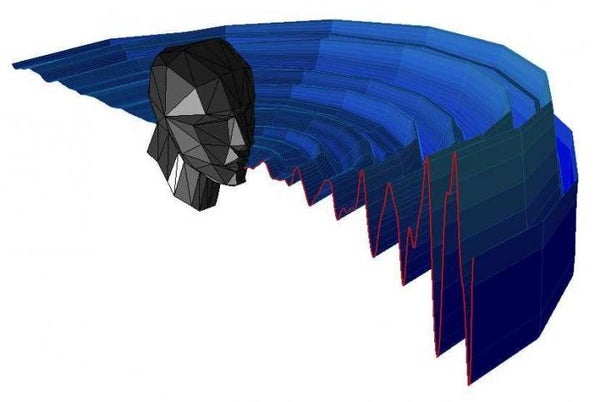

Many bats use a system similar to sonar to navigate in the dark. They send out high frequency sound, sometimes as clicks, and get information about their surroundings by the timing and quality of the sound that bounces back. And just as turning up the light in a darkened room helps to illuminate the objects there, bats are known to turn up the intensity of their clicks when they have trouble detecting a target.
"Now, bats have had millions of years of evolution basically to develop these mechanisms to dynamically adjust their emissions." Lore Thaler, a neuroscientist at Durham University in the U.K. "And what we were wondering is, well, do people do the same?"
Because some people with impaired vision can indeed navigate using the echoes of finger snaps, hand claps, or mouth clicks <
On supporting science journalism
If you're enjoying this article, consider supporting our award-winning journalism by subscribing. By purchasing a subscription you are helping to ensure the future of impactful stories about the discoveries and ideas shaping our world today.
You can try this at home by the way, with a plate or a book. "And if you hold it very close to your face while you're speaking you can notice that the sound that you hear really changes. This is because the sound that comes out of your mouth when you speak is reflected by the object you're holding in front of you. And that's an echo."
But move the plate 45 degrees to the side…then 90…then behind your head. And the task gets harder. But similar to the way bats do, the study subjects increased the number of clicks, and their loudness, <
The subjects still had trouble detecting the object a full 180 degrees behind them—they did only slightly better than chance. But they guessed correctly 80 percent of the time when the object was diagonally behind them. And nabbed nearly perfect scores when the disc was to the front or to the side. The results are in the Proceedings of the Royal Society B. [L. Thaler et al.,
Human echolocators adjust loudness and number of clicks for detection of reflectors at various azimuth angles]
Thaler says the study gives echolocating learners a shortcut: "If you're not sure, make a couple more clicks, and also make them louder." To produce echoes that more accurately reflect the world.
—Christopher Intagliata
[The above text is a transcript of this podcast.]
