
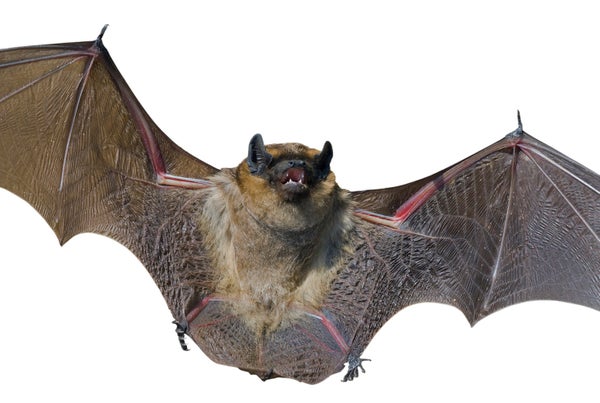

Just as humans understand the shape of our surroundings by how light reflects off objects, bats use reflections of sounds they produce instead—what’s called echolocation. But despite their excellent sensing abilities, one type of obstacle vexes the animals: smooth vertical surfaces, like windows. Because windows reflect almost all the bats’ calls away from bats at an angle—creating the illusion of empty space.
"To better understand it you can actually use a visual analogy." Stefan Greif, a sensory ecologist at the Max Planck Institute for Ornithology. Imagine standing in a dark room, he says, beside a mirror. "If then if you take a flashlight in your hand and shine it on the side onto this mirror, you would see that all the light is reflected away. You'd see it on the other side of the wall. So even visually this would look to you like there's a hole in the wall. There's nothing coming back from this place."
Light wouldn't come back to you unless you aimed the flashlight more or less perpendicular to the mirror—and same for bats and their calls. This perceptual glitch meant that in lab tests 90 percent of bats banged into a smooth vertical surface. (And by the way, the researchers say that none were hurt.) But here's the interesting bit: bats never smashed into a smooth horizontal surface.
On supporting science journalism
If you're enjoying this article, consider supporting our award-winning journalism by subscribing. By purchasing a subscription you are helping to ensure the future of impactful stories about the discoveries and ideas shaping our world today.
Greif says that's because plenty of horizontal planes exist in nature, like lakes and ponds. And even though a lake reflects calls away from the bat, bats have evolved to perceive the absence of sound reflections from horizontal surfaces as water. In fact previous studies have shown that bats will actually dip down for a drink from smooth horizontal surfaces—whether they're water-filled or not. The study is in the journal Science. [Stefan Greif et al., Acoustic mirrors as sensory traps for bats]
So what are conservationists to do? "Obviously we have to be realistic, right? We can't start making all our windows rough and textured." But if we build near crucial bat habitats, we could install acoustic deterrents to drive the flying mammals away from buildings. "And certainly you could start looking at architectural possibilities, if you don't make a smooth surface smooth all the way but make ridges inside, like a mosaic." And perhaps bat-friendly architecture would result in new designs…pleasing to human perception, too.
—Christopher Intagliata
[The above text is a transcript of this podcast.]
