
I have been a Scientific American subscriber since I was 12 years old. I think if I could ask that kid if he expected to see his name in the magazine one day, he’d say yes, but he would be surprised to find it on this particular page and not in one of the stories of great discoveries that follow. He wanted to grow up to be an astrobiologist and was certain the SETI program would discover an extraterrestrial radio signal soon; the only doubt he would have had was whether he’d be lead scientist in the subsequent SciAm article or only a junior member of the team.
Of course, SETI is still searching, and my name is on this page, not among the world’s great scientists. But I could not be more thrilled and honored to introduce myself as Scientific American’s new editor in chief.
I was lucky to grow up in a time when science was celebrated and great communicators told American children that science was not only a worthy career but also exciting and cool. I could turn the television to PBS and watch Carl Sagan in Cosmos or Alan Alda in Scientific American Frontiers; flip it to the news, and I’d see space shuttle liftoffs, high-temperature superconductors and the launch of the Human Genome Project.
On supporting science journalism
If you're enjoying this article, consider supporting our award-winning journalism by subscribing. By purchasing a subscription you are helping to ensure the future of impactful stories about the discoveries and ideas shaping our world today.
Unfortunately, the world of today is increasingly hostile to science. Our leaders deny the existence of human-driven climate change and vilify vaccines that have saved hundreds of millions of lives. Schools lack funding for STEM courses, and budgets are slashed at leading research institutions such as the NIH, NASA and NOAA. Earlier this year I spoke to a top-of-the-class postdoc who’d given up on the idea of securing a position at their U.S. alma mater and instead was weighing offers to relocate to Europe or China.
That makes Scientific American more important than ever. In our very first issue, dated August 28, 1845, editor Rufus Porter offered the publication as an advocate of science and industry and promised it would “instruct while it diverts or amuses.” My goal as editor in chief is to uphold those values, to stand up for science, to promote its application in industry, and to help educate and inspire new generations of young scientists. I hope to ensure that our coverage is centered on meaningful research and discovery and that it supports working scientists at a time when the value of science itself too often goes unrecognized.
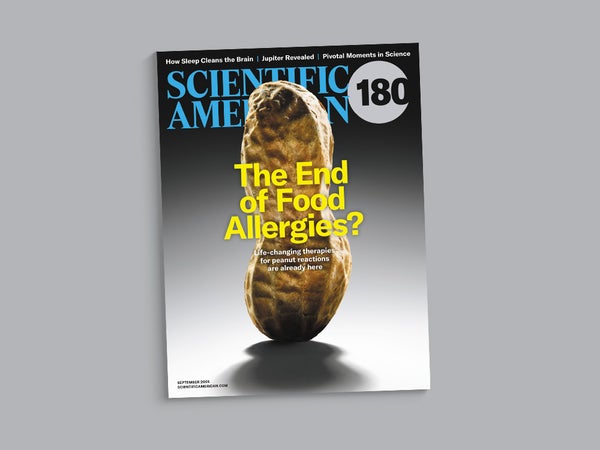
Given this context, I’m particularly excited that my first issue as editor in chief marks the 180th anniversary of Scientific American. Our celebration begins with an outstanding collection of stories about times when science itself has made 180-degree turns, including by abandoning ideas such as that light is a wave traveling through “aether,” that nerves don’t regenerate, and that the expansion of the universe is slowing. The anniversary party continues online, so don’t forget to check out our website at sciam.com over the course of the coming months, too.
In our cover story, journalist Maryn McKenna looks at the perplexing world of peanut allergies. Food reactions are probably as old as time, and researchers now estimate that they affect one out of 10 Americans overall and two kids in every classroom. But peanut allergies didn’t become widespread until the 1990s. Thankfully, remarkable new treatments might free millions of people from the deadly threat of anaphylaxis or even end food sensitivities once and for all. It’s an extraordinary example of the way that science can make the world a better place. And that’s the perfect way to kick off our next 180 years.
I’m glad that I have this soapbox to stand on at a time when our nation hungers for meaningful discovery and the scientific community needs everyone’s support. I hope you’ll stand with me. Scientific American helped shape the way I look at the world. It has always educated and delighted me, and I suspect it’s done the same for you, too. I’m looking forward to exploring the future together.