
The heroes of the COVID-19 pandemic are legion: nurses, doctors and others who care for the sick; epidemiologists and public health experts who track the disease and offer clear lifesaving guidance; and everyone who masks up and avoids crowds and protects their own health and the health of their communities. And around the world many scientists are working practically nonstop to understand the virus, how it spreads and what it does to the body.
We learned more about the immune system in 2020 than in any year in history. Akiko Iwasaki heads one of the labs leading the global effort to save people from COVID-19. She and grad student Patrick Wong explain how the immune system reacts to the new virus and how that knowledge might lead to new treatments. They describe how their team took on the urgent challenge and how the process of science changed in 2020.
Understanding the process of science can protect people against misinformation—or at least we hope so. One of the outrageous myths about the pandemic is that the death toll is exaggerated. It's not. More than a quarter of a million people in the U.S. have died of COVID-19 as of November. Journalist Christie Aschwanden details how we know the disease has become the third leading cause of death in the U.S.
On supporting science journalism
If you're enjoying this article, consider supporting our award-winning journalism by subscribing. By purchasing a subscription you are helping to ensure the future of impactful stories about the discoveries and ideas shaping our world today.
One of the most intriguing stages in the process of science is noticing when something is ... weird. Astronomers using new tools to see parts of space that had been shrouded by dust have observed that galaxy clusters formed much faster than anyone expected and that they seem to be too big for our universe. Grad student Arianna S. Long recounts the excitement of rethinking the time line of the early universe and how any unusual discovery is first assumed to be a software bug before it is accepted. Turn here.
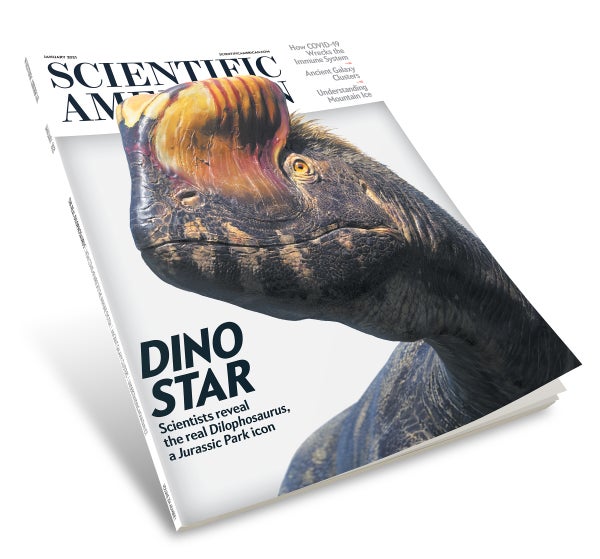
We're in a great age of dinosaur discoveries. Starting here, fossil experts Matthew A. Brown and Adam D. Marsh show how much has been learned about Dilophosaurus, our cover Dino Star, since it appeared in the film Jurassic Park in 1993. They point out that paleontology is more tedious and less glamorous than how it's depicted in movies, but understanding the bodies and habitats and behaviors of a 183-million-year-old dinosaur is the next best thing to bringing it back to life.
Some data are harder to gather than others. To understand the water cycle that sustains billions of people, mountain hydrologist Walter Immerzeel and his colleagues camp at 5,300 meters elevation (about 17,400 feet) and go higher to set up monitoring stations that have been twisted by winds and knocked over by avalanches. As he reports here, climate change is disrupting ice melt, monsoons and river flows, and the consequences could be catastrophic.
Evolutionarily, we are all well-functioning cellular civilizations, according to psychologist and evolutionary biologist Athena Aktipis. Multicellularity has a lot of advantages, and it has led to exquisite cooperation. But when some cells cheat, they can threaten the entire organism. Thinking of cancer cells as cheaters has led to new approaches to treatment.
When things get tumultuous on our planet, it's a nice escape to look at another one. The Mars Reconnaissance Orbiter has been photographing the Red Planet for 15 years now, and senior editor Clara Moskowitz shares some of the most gorgeous views. They reveal that Mars has dust devils, landslides and asteroid impacts just like Earth does.
All of us at Scientific American wish you a Happy New Year. We hope your 2021 is healthy and full of pleasant discoveries. And may science keep showing us more ways to save lives.