
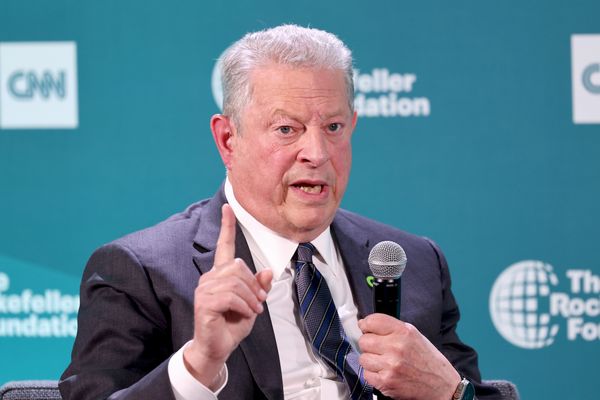
In 2006 former vice president Al Gore sounded the alarm on climate change in the documentary An Inconvenient Truth. In the film, he implored the world to wake up and take urgent action to reduce fossil fuel use and avoid the worst outcomes of global warming. Yet in the 20 years since, carbon dioxide concentrations in the atmosphere have risen significantly, and Earth’s temperature has warmed by about 0.7 degree Celsius (1.3 degrees Fahrenheit).
Now global temperatures hover around 1.5 degrees C (2.7 degrees F) above preindustrial levels—the limit agreed to in the landmark 2015 Paris climate agreement—and the United Nations recently warned that the world is set to overshoot that goal. With the urgency of reining in greenhouse gas emissions compounding, Gore has continued his Nobel Peace Prize–winning advocacy work. He’s still optimistic that humanity can prevent the worst harms of climate change and that this could be the year it begins to turn things around—if we choose to.
The moral case for making that choice was the topic of an event at Riverside Church in New York City on Friday, ahead of Climate Week NYC and the meeting of the U.N. General Assembly. Before Gore spoke there, he sat down to answer questions from Scientific American and a few other outlets, including APB News and Bloomberg.
On supporting science journalism
If you're enjoying this article, consider supporting our award-winning journalism by subscribing. By purchasing a subscription you are helping to ensure the future of impactful stories about the discoveries and ideas shaping our world today.
[An edited transcript of the interview follows.]
SCIENTIFIC AMERICAN: It’s been 20 years since An Inconvenient Truth came out. Have things been going better or worse, in terms of climate action, than you feared back in 2006?
Well, to quote Charles Dickens, in a way, it’s the best of times and the worst of times. “The worst of times” in the sense that the impacts of the climate crisis have been every bit as severe as the scientists have warned us they would be—in some cases, even more so.
But there are also instances of very, very good news that [have] emerged over the past 20 years. There has been a nearly miraculous development of solar energy, in the reduction of the cost to the point where it’s now the cheapest power in the history of the world by far; the development of utility-scale batteries that have come down in cost even faster than solar panels; wind energy; electric vehicles. This year was the first time that solar overtook coal, both in China and in the U.S.
And now that we have the second massive global disruption of fossil fuel availability and price in just four years, many nations around the world have awakened to the fact that this is a time to accelerate the transition. We have all the technologies we need right now to reduce emissions by half in 10 years. We know how to do it. We’re gaining momentum, but we’re not moving fast enough.
It is a moment of decision, and in spite of the current leadership in the U.S., I do believe that that there’s a real possibility that we will look back on the year 2026 as the turning point.
APB NEWS: U.N. secretary-general António Guterres said there are three urgent items facing the General Assembly: global conflict [amid inequality], AI and climate change. How important is it to keep climate change in front of world leaders?
I see one thing that all three of the secretary-general’s crises have in common. In each case, the most respected experts—whose advice has been proven correct over the years—have warned against neglect, have warned that we have to act.
In the case of the climate crisis, the Intergovernmental Panel on Climate Change has been proven to be spot-on in the warnings they’ve issued for decades, and yet their warnings are presently being ignored by the leadership of this country. The fact that they’ve been proven right in their past warnings should cause us to pay more attention to the warnings they’re giving us now.
BLOOMBERG: We’re seeing a lot of companies pull back on their climate targets. Do you think that voluntary corporate climate commitments are actual drivers of decarbonization in the economy?
It’s actually a complex question. There’s a lot of what’s called “green hushing,” where businesses now are continuing with the switch over to renewable energy but being quiet about it because they live in terror of tweets. There are many in the business community who have been cowed by Trump, not only into silence but also into reversing their policies. That is not true in most of the rest of the world, and it's not true in much of the U.S. either.
It’s true that too many investors and the 65 largest world banks continue to put trillions of dollars into more and more fossil fuels. But 10 years ago, at the time of the Paris Agreement, 65 percent of global energy investment was in fossil fuels, only 35 in renewables. Today 55 percent is in renewable energy. There is now twice as much investment in clean technology as there is in fossil fuels. So we are gaining momentum. We are just not gaining momentum quickly enough.
Too many governments in the world have been captured by the fossil fuel industry and the petrostates. Taxpayers around the world are actually subsidizing the burning of fossil fuels at the rate of $4.5 trillion per year. [Editor’s Note: Estimates of subsidies range from around $1 trillion to $7 trillion per year.] So when some say, “We’ve got to do more to accelerate renewable energy,” and someone else asks, “Well, where is the money going to come from?” Well, that’s a good place to get the money. Just stop subsidizing fossil fuels. It’s almost the exact amount the world needs to accomplish this transition at a speed that’s appropriate for the occasion.