New Issue: Orbital Catastrophe Ahead? Read Now

3,000-light-year-long jet offers new clues to first black hole ever imaged

Astronomers have traced the origin point of a jet of material that is thousands of light-years long emanating from the supermassive black hole M87*

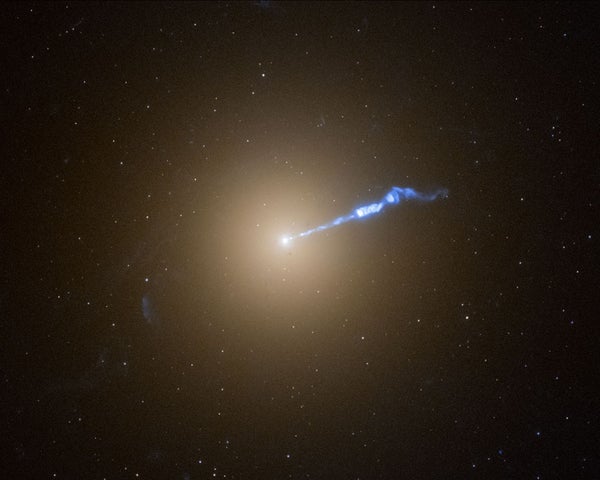
A bright light with a thin, blue-white jet spewing to the right.

The galaxy Messier 87 (M87) and a 3,000-light-year-long jet of plasma blasting from its central black hole.

NASA/ESA/STScI/Alec Lessing/Stanford University/Michael Shara/AMNH (image); Edward Baltz/Stanford University (acknowledgment); Joseph DePasquale/STScI (image processing)

Join Our Community of Science Lovers!

Located at the center of the galaxy Messier 87 (M87), the supermassive black hole M87* holds a special place in the science history books: it’s the first black hole ever imaged and is the origin of what NASA has called “one of nature’s most amazing phenomena.” That’s because the black hole is spewing out a gigantic jet of material that is blazing a 3,000-light-year-long trail through the cosmos.

M87* is both a messy and greedy eater: as dust and gas falls toward it, the black hole shoots out powerful jets of charged particles. But astronomers didn’t exactly know where these jets originated—until now. In new research published in the journal Astronomy & Astrophysics, scientists lay out evidence of what they believe are the “first hints” of M87*’s jet base.

Using observations from the Event Horizon Telescope, the team examined the glowing ring of superhot material around M87* and identified what they believe is the “probable position” of the extremely long jet’s origin.


On supporting science journalism

If you're enjoying this article, consider supporting our award-winning journalism by subscribing. By purchasing a subscription you are helping to ensure the future of impactful stories about the discoveries and ideas shaping our world today.
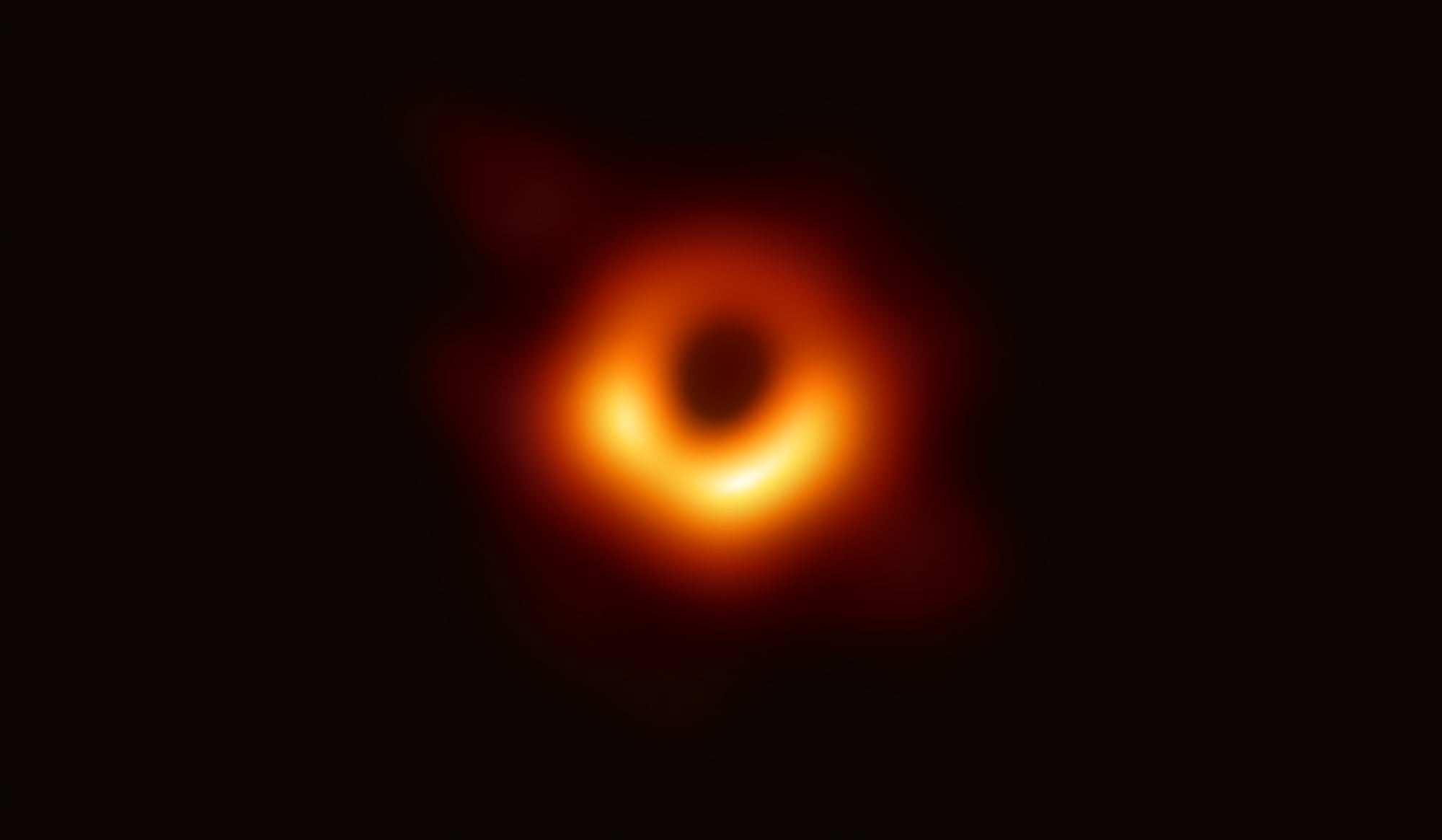

A blurry ring of light

The first image of the black hole at the center of the galaxy M87. The image was released April 2019.

Event Horizon Telescope Collaboration

The results could inform future studies of M87*’s superlative jet and the mechanics of similar supermassive black holes.

“This study represents an early step toward connecting theoretical ideas about jet launching with direct observations,” said the paper’s lead author Saurabh, a researcher at the Max Planck Institute for Radio Astronomy in Bonn, Germany, in a statement.

“Identifying where the jet may originate and how it connects to the black hole’s shadow, adds a key piece to the puzzle and points toward a better understanding of how the central engine operates,” he said.

Jackie Flynn Mogensen is a breaking news reporter at Scientific American. Before joining SciAm, she was a science reporter at Mother Jones, where she received a National Academies Eric and Wendy Schmidt Award for Excellence in Science Communications in 2024. Mogensen holds a master’s degree in environmental communication and a bachelor’s degree in earth sciences from Stanford University. She is based in New York City.

More by Jackie Flynn Mogensen

Subscribe to Support Independent Journalism

Great science journalism requires human expertise, time, effort and creativity. And it costs money. That’s why I and the journalists here at Scientific American hope you’ll join our community.

When you subscribe, you are supporting staff and freelance journalists who are passionate about telling science stories that are true, important and compelling. Our editors and reporters are often experts in their fields, which means they understand the nuances of big discoveries and can untangle the breakthroughs from the hype. With a subscription, you are also supporting rigorous fact-checking to ensure the words we publish are precise and accurate. And you’re supporting original illustrations, graphics and photos that bring you closer to an advanced laboratory, an ice sheet in Antarctica or a space mission in orbit. You’re helping us craft other types of high-quality journalism as well: Our newsletters are carefully written, edited and curated by staffers you have or will come to know and love. Our Science Quickly podcast is based on original reporting, collaboration with editors and scientists and exacting production.

Subscriptions keep this engine running so we can continue to deliver thoughtful, rigorous and independent science journalism to you. In an era of viral misinformation, this work is crucial. If you value what we do, I hope you’ll consider joining us as a subscriber

Thank you,

Jeanna Bryner, Editor in Chief, Scientific American

Subscribe