
1968
The Politics of Riots
“A view of the U.S. urban riots of the past four years as a ‘pre-political’ form of collective action rather than a series of senseless outbreaks of blind rage is beginning to emerge among social scientists. While there is no consensus among investigators, all of whom agree that the riots have varied and complex origins, there is general emphasis on the idea that the disorders represent more than a Negro protest, more than a sudden reaction to years of deprivation. The riots are seen rather as implicitly political demonstrations, although not as organized, conspiratorial political acts. This view is illustrated by a number of papers on urban violence and disorder in a recent issue of the American Behavioral Scientist. ‘Rioting evolves as a form of collective pressure or protest where large numbers of people are crowded and alienated together, sharing a common fate that they no longer accept as necessary.’”
On supporting science journalism
If you're enjoying this article, consider supporting our award-winning journalism by subscribing. By purchasing a subscription you are helping to ensure the future of impactful stories about the discoveries and ideas shaping our world today.
Daily Bread
“The disappearance of stones in the urinary tract is particularly well documented in England. Between 1772 and 1816 one in every 38 patients at the Norfolk and Norwich Hospital was under treatment for bladder stones. In the same period so many of the boys at the Westminster School in London suffered from bladder stones that they had their own hospital ward. A factor that may be related to the decline of stones, Dame Kathleen Lonsdale of University College London suggests, is that the bread the English ate during the 19th century was heavily adulterated with alum and chalk.”
1918
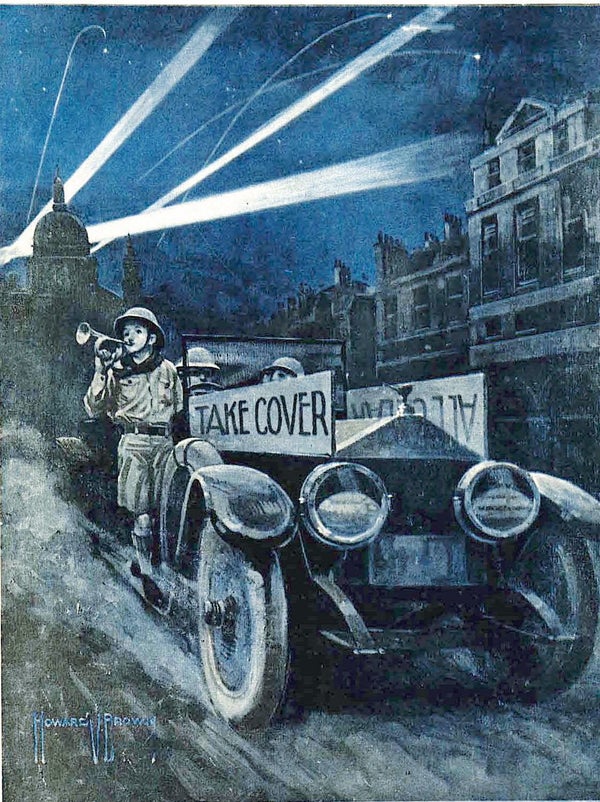
Raising the Alarm
“An organization of automobile owners in London has rendered valuable service to the public in connection with the raids of the German air pirates. When warning of an air raid is received in the city, explosive sky rockets are fired from various points. As depicted on our cover this week, the automobiles then drive through the city streets, honking their horns to attract attention. On each side of the car, a large sign is carried, on which is printed the warning, ‘Take Cover.’ When the danger is passed the reverse side of the sign is shown, which reads, ‘All Clear.’ A Boy Scout bugler who rides in the car also assists to inform the citizens that the Huns have departed.”
1868
Visiting Vesuvius
“At a recent meeting of the Royal Institution, Professor Tyndall was invited to state what he saw during his recent visit to Vesuvius. The country all round Naples is very smoking and hot, showing the existence of extensive subterranean fires. He also explored some hot subterranean galleries in the side of the mountain, and visited the Grotto del Cano, the well-known cavern, where the floor is covered several feet deep with carbonic acid gas [carbon dioxide]. The heavy invisible gas, in fact, runs out of the cavern in a great stream, and will in the open air put out torches when they are held near the ground. A little dog is kept near the cave to be half suffocated by immersion in the gas when visitors arrive; and Professor Tyndall protested against the cruelty of the experiment, which, he says, serves no useful purpose, and ought to be stopped.”
The Dust Bin
“There is not one particle in the heap the scavenger removes from our houses that is not again, and that speedily, put into circulation and profitably employed. No sooner is the dust conveyed to the yard of the contractor than it is attacked by what are called the ‘hill women,’ who, sieve in hand, do mechanically what the savant does chemically in his laboratory, separate the mass, by a rude analysis, into its elements. The most valuable of these items are the waste pieces of coal, and what is termed the ‘breeze,’ or coal dust and half-burnt ashes. The amount of waste that goes on in London households in this item of coal can hardly be conceived.”
Médecine Moderne
“The use of raw meat in the treatment of debility and consumption is in the ascendant in France: but that it may be served in a style the least objectionable to the patient's delicate sensibilities, it is prepared under the name of musculine tablets, and is made of raw fillets of beef covered with fruit jelly and candied sugar.”
.png?w=1350)