
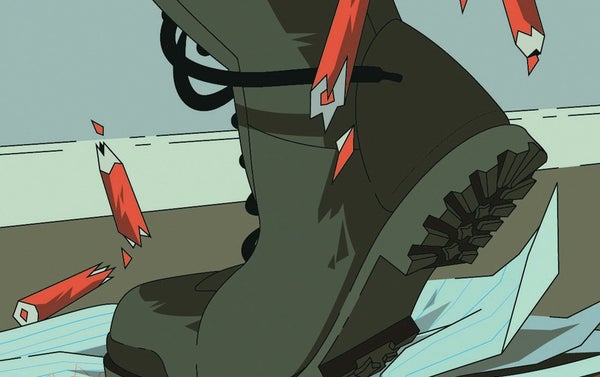
In October 2017 Joy Bishara recounted to United Nations Security Council members her experience of being one of nearly 300 girls abducted in 2014 from a boarding school in Nigeria by the Islamist group Boko Haram. She described to a hushed audience how, after her capture, she jumped from a moving truck and ran through the bush for hours to escape. More than 100 of her classmates remain in captivity.
Before the kidnapping, the girls—and their families—thought that they were in a place dedicated to learning and fun. And with good reason. Schools are meant to be safe zones, not war zones.
All too often, however, that is not the case. Around the world, troops use schools and universities as barracks, observation posts, weapons depots or centers for interrogation. The Global Coalition to Protect Education from Attack, made up of major U.N. agencies and nongovernmental organizations (NGOs), such as Human Rights Watch, has recorded a range of incidents since 2013, including killings, torture, abductions and forced occupations involving students, teachers, and schools and universities in 32 countries. In 2016 alone, the U.N. documented assaults on nearly 500 schools in 18 of the 20 nations designated as conflict countries.
On supporting science journalism
If you're enjoying this article, consider supporting our award-winning journalism by subscribing. By purchasing a subscription you are helping to ensure the future of impactful stories about the discoveries and ideas shaping our world today.
Keeping schools safe is a critical public health issue in strife-torn regions. Educational sites are more than just places for learning to read and count; they can also serve as refuges from the psychological impact of living in a war zone and as centers to furnish health information and instruction in protective measures, such as ways to avoid land mines.
A document known as the Safe Schools Declaration was put forward in 2015 at an international conference in Oslo. Developed in consultation with foreign ministries, defense and education officials, and the International Committee of the Red Cross, among other groups, it stipulates that countries agree to assist victims of attacks on schools; help to keep classes running; investigate violent incidents; promote “conflict-sensitive” education policies to lessen tension among diverse social or ethnic groups; and implement various other measures.
Dozens of countries have signed on, but notably absent on the list are 10 of the 15 members of the U.N. Security Council, including the U.S., China, Russia and the U.K. Officials from these countries have argued that an endorsement increases their commitments beyond what is specified by the Geneva Conventions and other international law.
Signatories are not legally bound by the agreement, but that does not make it by any means an empty statement. A number of signing nations have already taken concrete steps to defend schools. Somalia's defense ministry, for example, has expanded its child protection unit. The education ministry in Afghanistan has cited the declaration in attempting to remove military checkpoints and barracks from school facilities. Nigeria has bolstered school security. Efforts go beyond enlisting government help. NGOs have sought to steer armed opposition groups in Africa, Asia and the Middle East away from occupying schools.
Bringing the issue of keeping schools safe to the international stage has begun to yield real payoffs. Still, the sanctity of a school yard or university campus should be a lesson learned long ago. Protecting schools and teachers is an idea that goes back to the Romans. In A.D. 333 Roman emperor Constantine I told his subjects that professors of literature were relieved of the duty of quartering soldiers in their homes so that “they may more easily train many persons in the liberal arts.” Constantine I was not the only Roman ruler to make such proclamations.
The same month that Bishara spoke to the U.N., war-ravaged Yemen, where students have been killed by Saudi air strikes, became the 70th country to sign the Safe Schools Declaration. Every other nation that has yet to do so should follow suit.