
In 1906, astronomer and businessman Percival Lowell launched a search for "Planet X," a hypothetical giant planet orbiting the sun beyond Neptune. Lowell was convinced that Planet X existed based on some supposed irregularities he had observed in the orbits of Neptune and Uranus. His belief eventually led to the discovery of Pluto in 1930, though scientists later determined that the dwarf planet was too small to have a gravitational impact on Neptune's orbit (let alone Uranus').
Today, the Planet X hypothesis is largely considered to be discredited. However, that hasn't stopped astronomers from looking for planets in the far reaches of the solar system. And according to a new study, they might be out there — only much farther away than Lowell could have predicted.
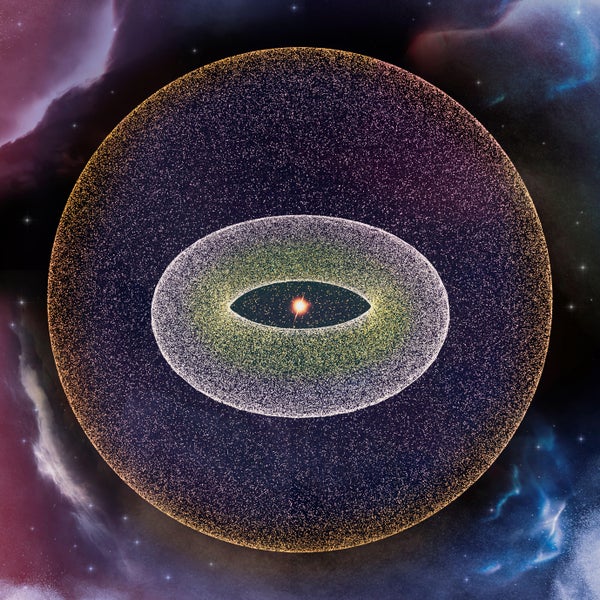
An international team of researchers recently simulated the unstable celestial mechanics of the early solar system. They found that there is a possibility that one or more planet-size bodies came to rest in the Oort cloud, a vast collection of icy objects stretching between a few hundred billion to several trillion miles from the sun, according to NASA. The new paper describing the work has been published to the preprint server arXiv and has yet to be peer-reviewed.
On supporting science journalism
If you're enjoying this article, consider supporting our award-winning journalism by subscribing. By purchasing a subscription you are helping to ensure the future of impactful stories about the discoveries and ideas shaping our world today.
Approximately 4.5 billion years ago, when the solar system was first forming, it was an unsettled place. Gravity sent debris from the rapidly cooling protoplanetary dust cloud pinging around like cosmic pool balls. Occasionally, the researchers calculated, large pieces of debris — even planet-size ones — would have been hurled far enough to escape the sun's gravity altogether.
Scientists have observed such "rogue planets" wandering around in distant solar systems. According to the researchers, there's about a 0.5% chance that one of these wayward planets might have formed in our own system and ended up in the Oort cloud as it drifted away from the sun.
But, the team calculated, it's slightly more likely that a rogue, Neptune-like planet from another solar system was snagged by the sun's gravity and came to rest somewhere in the Oort cloud. The chances of this are about 7%, and if this is the case, then an object akin to Lowell's long-sought Planet X might be out there after all, though it would still be too far away to influence Neptune's orbit.
However, the researchers think it's most likely that the Oort cloud is made of a collection of much smaller icy objects. Given the size and distance of the Oort cloud, though, we may never know for sure what's lurking out there.
Copyright 2023 LiveScience, a Future company. All rights reserved. This material may not be published, broadcast, rewritten or redistributed.