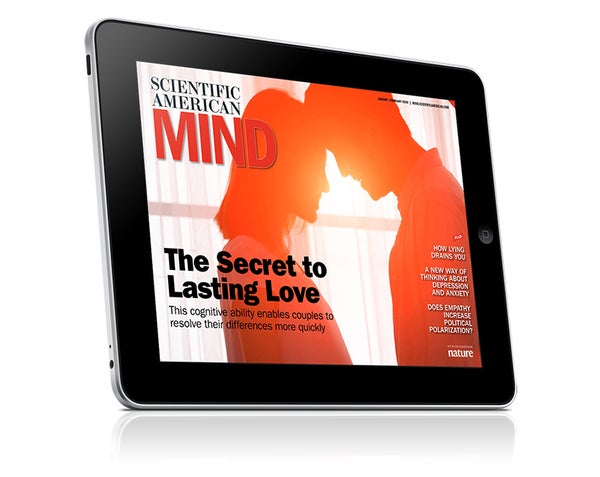
A Cognitive Secret for Improving Romantic Relationships

The latest brain science on love and play in Scientific American Mind

Ryan King Getty Images; Scientific American Mind January 2020

Join Our Community of Science Lovers!

In 2014 mathematician Hannah Fry gave a TED talk where she presented the following set of equations that predicts the positivity of interactions between spouses:

Though they look complex, the two equations predict how each spouse will respond to the other depending on their respective moods and influence over each other. The reasoning goes that more positive interactions will lead to a more positive marriage. Couples everywhere seemed to have a simple prescription: be more positive than negative, and you’ll have a better chance at success. Now a recent finding adds a neuroscientific element to the balance. As David Z. Hambrick and Daisuke S. Katsumata write, individuals who score high in working memory have less enduring conflict in their romantic relationships (see “How Research on Working Memory Can Improve Your Romantic Relationship”). This suggests that trying to resolve conflicts requires you to pay closer attention to what your partner is saying. And don’t forget to stay positive as much as possible. And take out the trash more often.


On supporting science journalism

If you're enjoying this article, consider supporting our award-winning journalism by subscribing. By purchasing a subscription you are helping to ensure the future of impactful stories about the discoveries and ideas shaping our world today.


In perhaps more lighthearted news, neuroscientists Ryan P. Dalton and Francisco Luongo describe in this issue a fascinating experiment in which rats were taught to play hide-and-seek while the researchers monitored their brain activity (see “Play May Be a Deeper Part of Human Nature Than We Thought”). Specific neurons in the prefrontal cortex associated with reward lit up during the game, suggesting that the brain’s response to play is evolutionarily ancient. We are hardwired for fun, it seems. And that is a positive thought.

Andrea Gawrylewski is chief newsletter editor at Scientific American. She writes the daily Today in Science newsletter and oversees all other newsletters at the magazine. In addition, she manages all special editions and in the past was the editor for Scientific American Mind, Scientific American Space & Physics and Scientific American Health & Medicine. Gawrylewski got her start in journalism at the Scientist magazine, where she was a features writer and editor for "hot" research papers in the life sciences. She spent more than six years in educational publishing, editing books for higher education in biology, environmental science and nutrition. She holds a master's degree in earth science and a master's degree in journalism, both from Columbia University, home of the Pulitzer Prize.

More by Andrea Gawrylewski
SA Mind Vol 31 Issue 1This article was published with the title “In Love and Play” in SA Mind Vol. 31 No. 1 (), p. 2
doi:10.1038/scientificamericanmind0120-2

It’s Time to Stand Up for Science

If you enjoyed this article, I’d like to ask for your support. Scientific American has served as an advocate for science and industry for 180 years, and right now may be the most critical moment in that two-century history.

I’ve been a Scientific American subscriber since I was 12 years old, and it helped shape the way I look at the world. SciAm always educates and delights me, and inspires a sense of awe for our vast, beautiful universe. I hope it does that for you, too.

If you subscribe to Scientific American, you help ensure that our coverage is centered on meaningful research and discovery; that we have the resources to report on the decisions that threaten labs across the U.S.; and that we support both budding and working scientists at a time when the value of science itself too often goes unrecognized.

In return, you get essential news, captivating podcasts, brilliant infographics, can't-miss newsletters, must-watch videos, challenging games, and the science world's best writing and reporting. You can even gift someone a subscription.

There has never been a more important time for us to stand up and show why science matters. I hope you’ll support us in that mission.

Thank you,

David M. Ewalt, Editor in Chief, Scientific American

Subscribe