
Brains are the quintessential decision-makers, gathering and weighing information before choosing a path forward. But in the natural world, many simpler systems accomplish similar tasks. Cells use networks of chemical signals to determine when to reproduce or die. Even water could be said to “decide” whether it will freeze into a snowflake or a hailstone, given the transformation’s exceedingly complex physics, says Erik Winfree, a molecular computing researcher at the California Institute of Technology.
Winfree has long been intrigued by the physical world’s hidden information-processing abilities. For a recent study in Nature, he and his collaborators designed a group of artificial DNA strands that, together, can recognize patterns and categorize information. The system bears key similarities to the “neural network” algorithms that underpin many artificial-intelligence models.
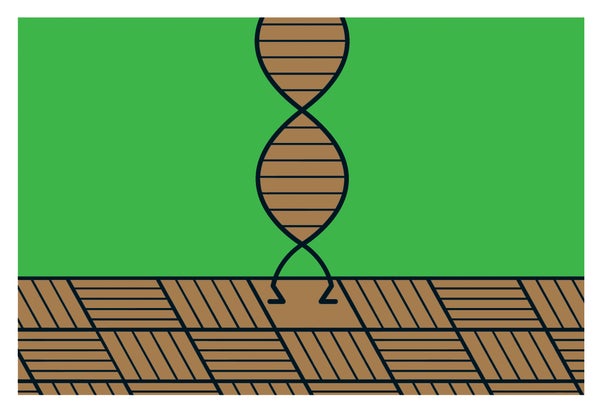
To build computerlike circuits with biological machinery, researchers often turn to self-assembling DNA molecules. These customized strands (or “tiles”) of DNA, when combined in a test tube and cooled, assemble into predictably shaped mosaics that can convey information.
On supporting science journalism
If you're enjoying this article, consider supporting our award-winning journalism by subscribing. By purchasing a subscription you are helping to ensure the future of impactful stories about the discoveries and ideas shaping our world today.
The scientists wanted to know whether that type of setup could recognize patterns—such as by sorting grayscale photographs into categories. To represent images in a test tube, the scientists created a code in which each image pixel corresponded to a particular “shape” of DNA tile. The lighter a pixel, the more of its corresponding DNA tile would be present in the solution.
When cooled, the tiles snapped together like a self-assembling jigsaw puzzle into one of three possible shapes, depending on the balance of DNA tile shapes in the mixture. Each shape represented a category, explains co-author Constantine Glen Evans, a molecular computing researcher now at Maynooth University in Ireland.
The system was built to sort 18 photos into three arbitrary categories, but it could also classify images it had never seen before, such as distorted versions of the same pictures. Like a neural network, it recognized general similarities in images “rather than looking for an exact match,” says co-author Arvind Murugan, a physicist at the University of Chicago.
The research is intended not to be an alternative to neural networks themselves but instead to reveal the computational abilities “that matter already has,” Murugan says. The scientists hope to find similar computational abilities within other systems in nature; such abilities “could be hidden in all kinds of things that we don’t notice,” Murugan says.
“It’s just intrinsically interesting,” says biomolecular engineer Rebecca Schulman of Johns Hopkins University, who was not involved in the new research. The fact that information can be stored implicitly through the interactions of large groups of molecules, similarly to how it’s stored in large groups of neurons in a neural network, “is something that I have never seen before,” she says.
The findings are like a first, fleeting glimpse at an “exotic” deep-sea ecosystem, Schulman adds. “It’s maybe a calling to go back and look harder.”