
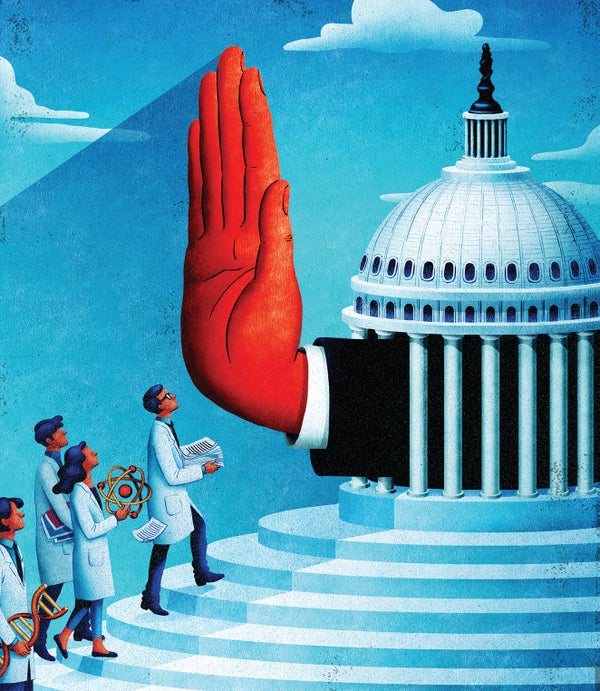
The White House and Congress have lost their way when it comes to science. Notions unsupported by evidence are informing decisions about environmental policy and other areas of national interest, including public health, food safety, mental health and biomedical research. The president has not asked for much advice from his Office of Science and Technology Policy, evidently.
The congressional committees that craft legislation on these matters do not even have formal designated science advisers. That's a big problem. Take the House Committee on Science, Space, and Technology. Its leader, Republican Representative Lamar Smith of Texas, clearly misunderstands the scientific process, which includes assessment by independent peer reviewers prior to publication. The result has been a nakedly antiscience agenda. The committee has packed its hearings with industry members as witnesses instead of independent researchers. Democratic members have felt compelled to hold alternative hearings because they feel Smith has not allowed the real experts to speak. Smith's misinformed leadership has made it clear that congressional science committees need to be guided by genuinely objective experts.
So far this year, Smith and fellow committee member Representative Frank Lucas of Oklahoma have each introduced bills that would seriously weaken the Environmental Protection Agency. Lucas's bill would help stack the EPA's Science Advisory Board with industry representatives and supporters. Smith's—the Honest and Open New EPA Science Treatment (HONEST) Act—would make it harder for the EPA to create rules based on good research. As Rush Holt, CEO of the American Association for the Advancement of Science, a former representative and a nuclear physicist, said of an earlier version of the bill, this sort of legislation is nothing less than an attempt to “fundamentally substitut[e] a [political] process for the scientific process.”
On supporting science journalism
If you're enjoying this article, consider supporting our award-winning journalism by subscribing. By purchasing a subscription you are helping to ensure the future of impactful stories about the discoveries and ideas shaping our world today.
This is lunacy. We should not allow elected officials—especially the heads of congressional science committees—to interfere with the scientific process, bully researchers or deny facts that fit poorly with their political beliefs. Instead of seeing science as a threat, officials should recognize it as an invaluable tool for improving legislation.
To educate members about the best available research, both the House and Senate science committees should create independent groups of impartial researchers and policy specialists to advise them on science and technology issues, including those related to energy, genetically modified foods, and clean air and water. (Industry representatives would still have a voice, but they would counsel the committees separately.) The advisers could provide counsel without advocating specific courses of action. The scientific community—perhaps the heads of the National Academy of Sciences—could select the advisers, who would serve limited terms. Policy makers would still make the decisions, but with help from experts, those decisions would at least be based on facts.
Congress used to have a body of this kind—the widely respected Office of Technology Assessment (OTA). The OTA was an office of Congress: it served members and committees, and a bipartisan board of senators and representatives oversaw it. Until 1995, the OTA created reports on scientific issues ranging from alternative fuels to cancer and presented Congress with options it could pursue to reach different goals. Then the Republican-controlled Congress axed its funding during budget cuts. Many have advocated for the OTA's return, including Scientific American. Last year Representative Bill Foster of Illinois introduced a resolution calling for its revival.
Whether it comes from a resurrected OTA, a new, dedicated advisory panel or some other body, independent, evidence-based advice on scientific matters would provide a strong counterbalance to the opinions of special interests. Science would get a voice, no matter who was in power. This voice could not force members of Congress to accept scientific truth over alternative “facts.” But at least it would give them the opportunity to do so.