
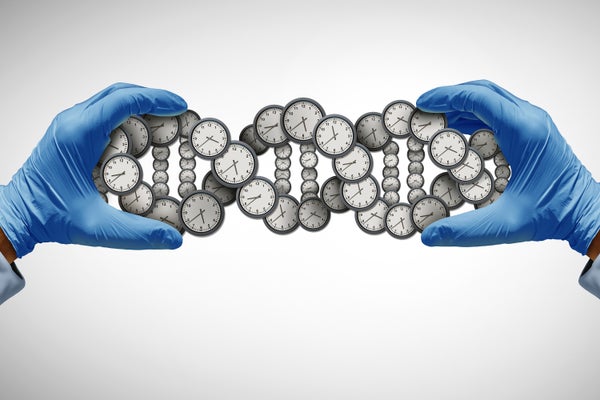
The visible effects of ageing on our body are in part linked to invisible changes in gene activity. The epigenetic process of DNA methylation — the addition or removal of tags called methyl groups — becomes less precise as we age. The result is changes to gene expression that are linked to reduced organ function and increased susceptibility to disease as people age.
Now, a meta-analysis of epigenetic changes in 17 types of human tissue throughout the entire adult lifespan provides the most comprehensive picture to date of how ageing modifies our genes.
The study assessed DNA methylation patterns in human tissue samples and revealed that some tissues seem to age faster than others. The retina and stomach, for example, accumulate more ageing-related DNA methylation changes than do the cervix or skin. The analysis also found universal epigenetic markers of ageing across different organs. This ‘epigenetic atlas’ might help researchers to study the link between DNA methylation and ageing and could aid the identification of molecular targets for anti-ageing treatments.
On supporting science journalism
If you're enjoying this article, consider supporting our award-winning journalism by subscribing. By purchasing a subscription you are helping to ensure the future of impactful stories about the discoveries and ideas shaping our world today.
“I think this is a great resource” to understand ageing, says Joao Pedro Magalhaes, a molecular biologist at the University of Birmingham, UK. “This meta-analysis of methylation data across organs is, to my knowledge, the largest such resource assembled to date. I am sure that it will be valuable to researchers.”
The work is reported on the preprint server Research Square and has not yet been peer reviewed.
Epigenetic atlas of ageing
Researchers can already analyse DNA methylation patterns in people’s genomes to create ageing clocks — tools that measure biological age. However, there are unresolved fundamental questions about whether these signatures of ageing are shared across tissue types.
To elucidate how methylation relates to ageing, Nir Eynon at Monash University in Melbourne, Australia, and his colleagues conducted a meta-analysis of more than 15,000 samples from 17 human tissues taken from adults of different ages. They mapped out methylation changes across 900,000 potential sites in the DNA, then created an open-access atlas. “We had examples from people from 18 years old till 100 or so,” says Eynon, so we can look at the epigenetic markers and how they change across the human lifespan.
Overall, the researchers found that the mean amount of methylation varies greatly between tissues, ranging from 35% in the cervix, through to 48% in skin, 51% in muscle, 53% in the heart, 57% in the stomach and up to 63% in the retina.
Study co-author Macsue Jacques, also at Monash University, says almost all tissues have increased DNA methylation as they age. The exceptions are skeletal muscle and lung, “which has more of a loss of methylation with age”. Their analysis also found that different organs have distinct ageing patterns of DNA methylation. “Each tissue has a different shift that happens,” Jacques says.
Ageing methylation targets
As well as examining differences between tissues, the researchers screened individual gene sites throughout each tissue genome. “We wanted to find a common ageing mechanism that goes across all the tissue types,” says Jacques.
They found several genes that had methylation changes were strong biological markers of ageing across several tissues. These included the developmental regulators HDAC4 and HOX, which are related to senescence and age-related decline, and MEST, which has been associated with diabetes and obesity, two known accelerators of ageing.
The researchers identified high methylation of the protocadherin gamma (PCDHG) gene family as a driver of the ageing process in multiple different organs. Other studies have shown that hypermethylation in the PCDHG gene family is linked to reduced white matter in the brain, a marker of accelerated cognitive decline.
Target body ageing, not tissue ageing
Jacques sees the atlas as a resource to accelerate discovery of the core molecular mechanisms of ageing throughout the body, as well as in individual tissues. She hopes that it could be a tool to boost the search for anti-ageing therapies: it raises the tantalizing idea of shifting from treating individual age-related diseases, such as cardiovascular disease or liver disease, to treating ageing as a whole.
Holger Bierhoff, an epigeneticist at the Leibniz Institute on Aging – Fritz Lipmann Institute in Jena, Germany, says that the big question with working on epigenetic clocks has always been ‘what is causing ageing?’. “This work looks into the functional relevance of the methylation, rather than just using it as a timepiece for ageing.”
Big as the study is, says Bierhoff, this is still a tiny fraction of the roughly 30 million epigenetic sites in the human genome, so it might not present the whole picture of age-related DNA methylation.
Eynon accepts that, but says that the data in their atlas could still help identify the mechanisms behind ageing and reveal how to slow it.
Previous work from a team involving Eynon has shown that exercise is associated with younger methylation patterns in human skeletal muscle, for example. “There's almost no tissue in the body that is unaffected by exercise,” he says, so this work might lead to a model of how exercise, and factors such sleep and diet, change pathways in many tissues throughout the body to keep us biologically younger.
This article is reproduced with permission and was first published on September 1, 2025.