New Issue: Orbital Catastrophe Ahead? Read Now

A Glitch Has Knocked the Hubble Space Telescope Offline—for Now

Although mission controllers have yet to identify the source of the problem, confidence is high the iconic observatory will soon return to normal operations

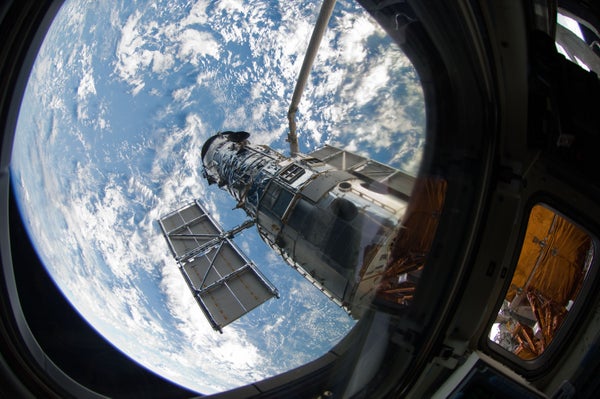
A view of the Hubble Space Telescope through a window on the space shuttle Atlantis, during the final servicing mission to the orbital observatory in 2009.

A view of the Hubble Space Telescope through a window on the space shuttle Atlantis, during the final servicing mission to the orbital observatory in 2009.

Join Our Community of Science Lovers!

It turns out it's tricky to troubleshoot a 1980s computer that's dashing around Earth hundreds of miles over our heads.

NASA has spent more than a week evaluating a computer issue that put the venerable 

Hubble Space Telescope out of commission on June 13 and that may force the spacecraft to turn to its backup computer. Now, ongoing tests suggest that the issue the team has identified so far may not be at the root of the computer's problems, according to an update from the agency.


On supporting science journalism

If you're enjoying this article, consider supporting our award-winning journalism by subscribing. By purchasing a subscription you are helping to ensure the future of impactful stories about the discoveries and ideas shaping our world today.


"After performing tests on several of the computer’s memory modules, the results indicate that a different piece of computer hardware may have caused the problem, with the memory errors being only a symptom," NASA officials wrote in 

a statement published Tuesday (June 22).

Although the initial anomaly suggested that a memory module was degrading, the team now suspects that the root of the issue might be in the computer's central processing module or that unit's connection with interface hardware.

Right now, the statement added, the team is designing tests to more confidently identify the problem; those tests "will be run in the next few days."

The NASA statement suggests that the team hasn't yet given up hope of reviving the main payload computer, but does lay out the plan for if that feat can't be accomplished. The telescope carries a backup computer that, like the main unit, was installed in 2009 during the final 

astronaut servicing mission but hasn't been used since.

"The backup computer has not been powered on since its installation in 2009; however, it was thoroughly tested on the ground prior to installation on the spacecraft," NASA officials wrote in the statement.

If the team is forced to turn to the backup unit, Hubble would switch to that unit's central processing module and interface hardware. Switching computers would not affect access to the four memory modules on the spacecraft, NASA noted.

Astronauts deployed the Hubble Space Telescope from the space shuttle Discovery on April 25, 1990; five crews of astronauts later visited the spacecraft in orbit to 

repair and upgrade the technology and instruments on board. However, NASA can no longer send such missions to fix the telescope, since they relied on the agency's fleet of space shuttles, which retired in 2011.

Copyright 2021 Space.com, a Future company. All rights reserved. This material may not be published, broadcast, rewritten or redistributed.

Meghan Bartels is a science journalist based in New York City. She was previously a senior reporter at Scientific American. Before that she spent more than four years as a writer and editor at Space.com, as well as nearly a year as a science reporter at Newsweek, where she focused on space and Earth science. Her writing has also appeared in Audubon, Nautilus, Astronomy and Smithsonian, among other publications. She attended Georgetown University and earned a master’s degree in journalism at New York University’s Science, Health and Environmental Reporting Program.

More by Meghan Bartels

SPACE.com is the premier source of space exploration, innovation and astronomy news, chronicling (and celebrating) humanity's ongoing expansion across the final frontier.

More by SPACE.com

Subscribe to Support Independent Journalism

Great science journalism requires human expertise, time, effort and creativity. And it costs money. That’s why I and the journalists here at Scientific American hope you’ll join our community.

When you subscribe, you are supporting staff and freelance journalists who are passionate about telling science stories that are true, important and compelling. Our editors and reporters are often experts in their fields, which means they understand the nuances of big discoveries and can untangle the breakthroughs from the hype. With a subscription, you are also supporting rigorous fact-checking to ensure the words we publish are precise and accurate. And you’re supporting original illustrations, graphics and photos that bring you closer to an advanced laboratory, an ice sheet in Antarctica or a space mission in orbit. You’re helping us craft other types of high-quality journalism as well: Our newsletters are carefully written, edited and curated by staffers you have or will come to know and love. Our Science Quickly podcast is based on original reporting, collaboration with editors and scientists and exacting production.

Subscriptions keep this engine running so we can continue to deliver thoughtful, rigorous and independent science journalism to you. In an era of viral misinformation, this work is crucial. If you value what we do, I hope you’ll consider joining us as a subscriber

Thank you,

Jeanna Bryner, Editor in Chief, Scientific American

Subscribe