
Now is the summer of our really, really big discontent. As I write in early August, our offices are still closed as the pandemic rages on. And some people who stop their vehicles at red lights chaff, figuratively, at wearing masks in public, because freedom. It is under these conditions I want to share some recent items I chanced on.
As the saying goes, “A man may work from sun to sun, but a woman's work will probably not be compensated to the same extent as a man's, and her salary as a percentage of the average in her field will likely go down should her field undergo a transition to majority female.” Hey, if it wasn't catchy, it wouldn't have become an axiom.
For examples of this phenowomenon, see an article entitled “When a Specialty Becomes ‘Women's Work': Trends in and Implications of Specialty Gender Segregation in Medicine,” published in Academic Medicine. The authors are Elaine Pelley and Molly Carnes of the School of Medicine and Public Health of the University of Wisconsin–Madison. Such an elite affiliation is instant grounds for nonpayment of attention among many of my fellow Americans these days, as it speaks to a certain level of knowledge and experience that they increasingly find, ya know, annoying.
On supporting science journalism
If you're enjoying this article, consider supporting our award-winning journalism by subscribing. By purchasing a subscription you are helping to ensure the future of impactful stories about the discoveries and ideas shaping our world today.
Despite their credentials, let's hear these authors out. They note that “pediatrics earned 93% of the average physician salary in 1975 when it was 22% female, but earned only 71% of the median physician salary in 2017 when it was 63% female.”
Another case: “The salaries in obstetrics and gynecology were 20%–25% higher than the mean physician salary in the mid-1970s and 1980s when the female share was 8% and 18%, respectively. However, by 2017 with a female share of 57%, an obstetrician/gynecologist became an average physician earner.” (An extreme version of this trend can be easily found with a Google search using the terms “women doctors Russia status.” The results could make you seek out a gastroenterologist of any sex.)
While wondering about the ethical implications of these financial disparities, I stumbled onto a 2016 paper by philosophers Eric Schwitzgebel and Joshua Rust entitled “The Behavior of Ethicists.” They basically attempt to determine if professional ethicists behave more ethically in their personal lives than other people (for ease of access to study subjects, the other people were nonethicist philosophers and professors in other disciplines). And they found that the ethicists don't bring work home: “On average, professional ethicists' behavior is indistinguishable from the behavior of comparison groups of professors in other fields.”
That finding makes sense to me. Because a while back, I attended a medical ethics symposium and had an insight—a jumping jack flash, if you will: Satan would make a terrific ethicist. To establish the most evil course of action in a given situation, he'd have to perform a comprehensive evaluation that would also reveal the best policy choice. Knowing right from wrong is thus a necessary but insufficient condition for goodness, and Old Nick could write excellent ethical white papers before setting them on fire.
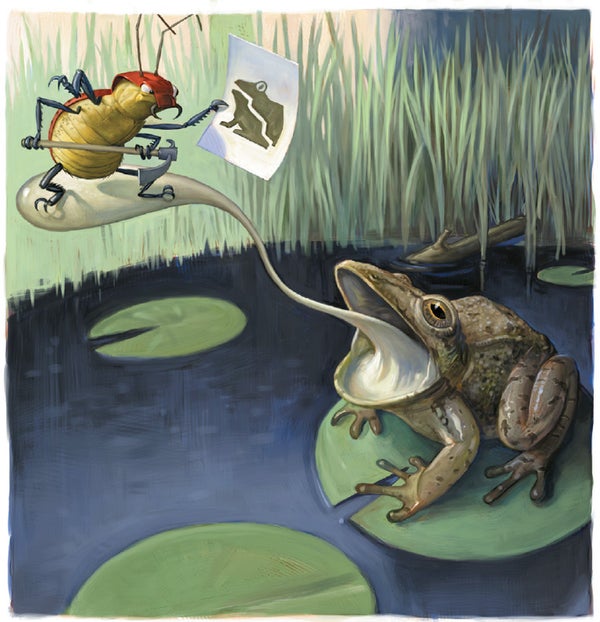
Speaking of hell, a study in the August 3 issue of the journal CurrentBiology revealed that the vast majority of members of a species of beetle, Regimbartia attenuata, perform a literally death-defying feat after being swallowed by various species of frogs. The beetle apparently swims its little heart out till it pops out of the frog's derriere. Because, as another axiom has it, “If you're going through hell, keep going.”
To find out whether the insect's passage was active or passive, researchers immobilized some beetles by coating them with wax before going into the mouth of hell, or rather, frog. None of these beetles survived. To paraphrase science-fiction legend Harlan Ellison (who definitely would have come up with this experimental protocol if he'd lived long enough): they really don't want to open their mouths, and they must scream.