
Editor’s Note (12/22/20): This story has been updated to reflect new records set through the November 30 end of the hurricane season.
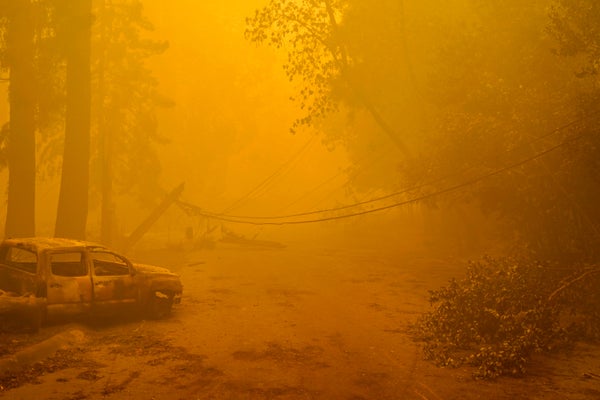
This year has been a standout year for all the wrong reasons, including its devastating natural disasters. Wildfires have ravaged the western U.S., and tropical cyclones have popped up left and right, with several causing significant damage to coastal areas.
Though they are called natural disasters, the toll they take comes in part from human actions. The buildup of communities in vulnerable areas, such as along the coasts and fire-prone areas of the West, means more people are in harm’s way. Climate change, fueled by greenhouse gas emissions from energy use and industrial processes, has also upped the ante. Hotter weather dries out the grasses and forest debris that can ignite, fueling bigger and longer-lasting wildfires. And rising seas and heavier downpours mean higher flood risks during storms.
On supporting science journalism
If you're enjoying this article, consider supporting our award-winning journalism by subscribing. By purchasing a subscription you are helping to ensure the future of impactful stories about the discoveries and ideas shaping our world today.
These factors have helped push some of this year’s disasters to surpass—and in some cases, shatter—previous records. This is a running list of all the ones that have been set this year.
Hurricanes
The 2020 Atlantic hurricane season was a doozy. Here are some of the records it achieved:
This is only the second time that the official alphabetical list of hurricane names has been used up, meaning forecasters have had to move to the supplementary list of Greek letter names.
The 2020 season surpassed 2005 as the one with the most named storms on record: 30. (Named storms are those that reach at least tropical storm strength, with winds of 39 to 73 miles per hour.)
Twenty-seven of the 30 storms that formed this season were the earliest of their storm number to do so. For example, Delta was the earliest 25th named storm of any season, beating out Tropical Storm Gamma, which formed on November 15, 2005.
When Tropical Storm Eta made landfall on Florida’s island of Lower Matecumbe Key on November 8, it became the only 12th named storm to hit the U.S. in a single season. It broke the record set just weeks earlier by Hurricane Zeta and Hurricane Delta before it. Prior to 2020, the season with the most landfalls was 1916, which had nine.
Hurricane Zeta was the sixth hurricane to hit the U.S. this year, tying 1886 and 1985 for the most continental U.S. hurricane landfalls in a single season.
Zeta was the record fifth named storm to hit Louisiana in a single season.
Delta’s landfall was the first time a Greek-alphabet-named hurricane has made landfall in the U.S.
Hurricane Iota was the latest known category 5 hurricane in the Atlantic, reaching that status on November 16. The old record, for November 8, was held by the Cuba Hurricane of 1932.
This November was the first on record to have two major hurricanes, Eta and Iota.
This was the record fifth consecutive year to see a category 5 storm form.
September, which falls within the peak of the hurricane season, saw a record 10 named storms form within the month. (The previous record was eight.)
In mid-September, there were five storms churning around the Atlantic Ocean simultaneously for only the second time on record.
September 18 marked the second time on record that three named storms—Wilfred, Alpha and Beta—all formed on the same day. The only other time this was known to happen was on August 15, 1893, before hurricanes received official alphabetical names.
(The Atlantic hurricane database, managed by the National Hurricane Center, extends back to 1851. The lists of alternating male and female hurricane names have been in use since 1979.)
Wildfires
Wildfires have taken an enormous toll on western U.S. communities, both from flames and harmful smoke. California bore the worst of it. Here are some of the records that were set:
Fires burned more than four million acres across California, about doubling the previous record of nearly two million acres set in 2018. Quality records of fires size in California go back to 1932.
The August Complex Fire alone burned more than one million acres, by far the largest in California’s history. The previous record of more than 459,000 acres was set in 2018 by the Mendocino Complex Fire.
Five of California’s six largest fires burned this year.
On October 14 Colorado’s Cameron Peak Fire surged to become the largest in state history, burning more than 208,000 acres and surpassing the record set less than two months prior by the Pine Gulch Fire.
Rain and Flooding
Heavy rain sent water levels in the Tittabawassee River to record highs in May, causing the failures of the Edenville and Sanford dams near Midland, Mich. Some 10,000 residents had to evacuate because of the subsequent floods.
Heat
Heat, especially over prolonged periods, can exacerbate existing health conditions and is one of the leading causes of weather-related deaths in the U.S. The Phoenix area saw notable heat this year.
Phoenix set a record for the most days with temperatures of 100 degrees Fahrenheit or higher with 144 days.
On Nov. 16, the city saw its latest 90-degree day on record, beating the previous record of Nov. 15.
Overall
Through September, the U.S. had 16 natural disasters (including wildfires, hurricanes, tornadoes and drought) that each caused at least $1 billion in damage, tying the record set in both 2011 and 2017—with several months left to go. Such statistics have been compiled since 1980.