
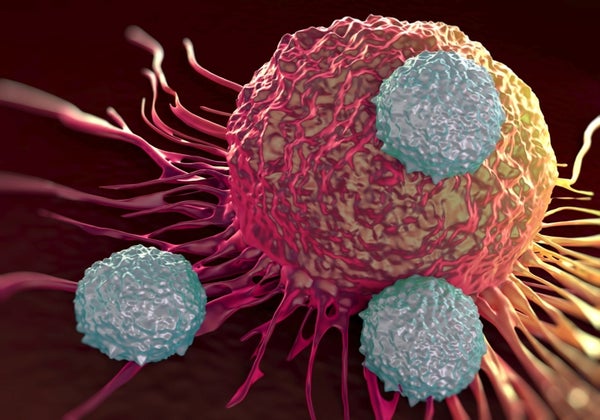
For more than a decade researchers have been trying to supercharge human defense systems against cancer with the help of a vaccine. These injections are not designed to prevent cancer from starting. Instead they provide patients' immune system with intel on what the enemy—cancer cells—looks like. Ordinarily, cancerous cells do not look different enough from normal cells to trigger an immune system response, but we have figured out ways to highlight and target some of the proteins that are unique to these malignancies.
Human cells are covered in so-called self-proteins that serve as identifying markers for the immune system. Like an ID card, they let the body know whether a substance belongs in the body and should not be attacked. Unfortunately, those proteins also dot the exterior of cancerous cells. Earlier cancer vaccine efforts, by our team and others, may have failed because they primed the immune system to look for proteins present—though at different levels—on both.
Recently, however, our team has managed to home in on proteins that are unique to the malignancies by scouring genome sequences of a patient's normal tissue and a tumor to identify proteins exclusive to the cancer. Then we study which cancer-specific proteins spark a strong response from immune molecules charged with directing the body's response to foreign substances, called major histocompatibility complex proteins, or MHCs. Using that information, we can create personalized vaccines that include MHC-containing dendritic cells from the patient that will grab the cancer proteins and present them to the immune system. That stimulus helps to generate antitumor T cell responses and marks cancer cells bearing those specific proteins for destruction.
On supporting science journalism
If you're enjoying this article, consider supporting our award-winning journalism by subscribing. By purchasing a subscription you are helping to ensure the future of impactful stories about the discoveries and ideas shaping our world today.
Last year we tried this approach with three melanoma patients. As we wrote in Science, we found seven cancer-specific proteins that would bind to each patient's MHC molecules. We were thrilled to see a response in all three subjects: three of the seven proteins were recognized by the patients' T cells, and those T cells attacked the patients' cancer cells.
A year later the patients' immune system continued producing antitumor T cells in the blood, suggesting that our vaccines could fight off tumor recurrences. (Two of our patients' tumors shrunk or stabilized, but because they received other therapies, too, we do not know what helped.) To date, all three patients are alive and stable and show no negative side effects from the vaccine.
Our work is still in its early days. We first selected melanoma to treat because it is a cancer with many mutations and protein targets, but we plan to test this approach with other cancers, too. Before our method could become part of routine cancer therapy, we would need to study how it affects tumors long term and speed up our vaccine production time. Eventually we would like to use these vaccines to complement other cancer immunotherapies. Ultimately, we hope, vaccines will give patients a better shot against cancer.