
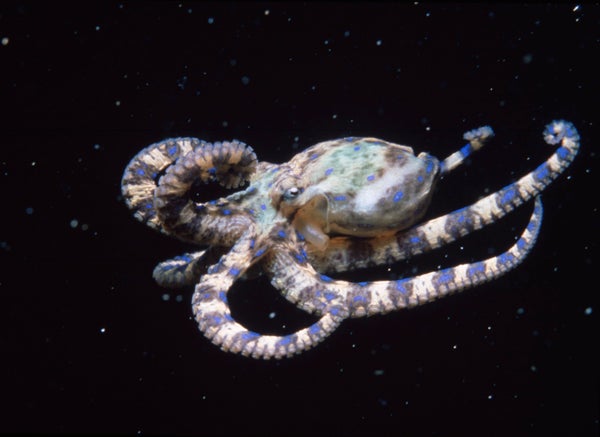
When it comes to animal intelligence, octopuses have few rivals. Some species of the cephalopods lug coconut shells around for mobile shelter; others radically transform their bodies to mimic deadlier creatures. Almost two decades ago in Germany, a particularly wily octopus named Otto short-circuited his aquarium’s electrical system by shooting jets of water at an overhead light that perhaps caused an objectionable glare.
Octopuses are as clever, in their own way, as such famously brainy animals as crows, dolphins or chimpanzees. But they’re endowed with a fundamentally different intelligence, one shaped by a separate evolutionary path and defined by a nervous system that’s distributed throughout their bodies rather than centralized like that of the brains of most animals.
Now researchers have discovered another surprise in octopuses’ biology: a mutation, never documented in any other animal, that makes their cells remarkably accurate at creating proteins and that appeared just as they began evolving large nervous systems. “We can’t make a direct relation [between] a slight change in the accuracy of protein synthesis and so-called advanced intelligence,” says Nicholas Bellono, a Harvard University molecular biologist. But he notes that the timing “maps perfectly” with the emergence of sophisticated behaviors in octopuses.
On supporting science journalism
If you're enjoying this article, consider supporting our award-winning journalism by subscribing. By purchasing a subscription you are helping to ensure the future of impactful stories about the discoveries and ideas shaping our world today.
Bellono and his colleagues, who published their work today in Current Biology, stumbled upon this evolutionary innovation by accident. Co-lead author Richard Han, then a graduate student in the lab of Harvard Medical School cell biologist Amy Lee, was examining octopus RNA—the molecules that carry the genetic instructions that cells use to build proteins—when he noticed an unusual break in the genetic sequences that formed ribosomes, the cell’s protein-making machines. This stretch of ribosomal RNA (rRNA) is identical across every other animal that’s been studied, so the deviation jumped out at Han. “Finding a difference here was really unexpected for us,” he says.
To figure out how this break affected ribosome function, the researchers engineered it into Escherichia coli bacteria. The altered bacteria made fewer mistakes when building proteins, which lowered the risk of misfolded molecules clumping together into disease-causing toxic aggregates. Next, the researchers compared octopus and squid tissue and found that the former did in fact have fewer and smaller protein clumps.
Though the advantages are obvious, it’s unclear why octopuses alone evolved this rRNA break. It seems exclusive to shallow-water octopus species, which split off from their deep-water counterparts roughly 100 million years ago to colonize a highly complex environment. Faced with more predators, prey and competition, their nervous systems rapidly ballooned to meet the new demands. And neurons, being long-lived, are especially vulnerable to protein clumps, according to the new study’s co-lead author Rishav Mitra, a postdoctoral fellow in Bellono’s lab. By preventing misfolded proteins, he says, the rRNA break “might help these neurons to work well.”
Other researchers say that a connection between the break and octopus intelligence is plausible, though it lacks direct evidence. “These associations are intriguing,” says Eli Eisenberg, a geneticist at Tel Aviv University, who wasn’t involved with the study, “but more proof is needed to support the hypothesis that they contributed to the evolution of neural complexity or cognitive capacity.” To truly establish that link, he says, you’d have to alter the rRNA break and test for changes in learning, sensory processing or problem-solving. “These experiments would of course be highly challenging,” Eisenberg adds.
The real value of this finding may lie in potential health care applications. In humans, protein clumps play a role in many neurological diseases, including Alzheimer’s and Parkinson’s. Lee hopes it will be possible to design drugs that target ribosomes to mimic the octopus’s useful trick for superaccurate protein synthesis, reducing the burden of misfolded molecules. If we “use nature as a guide to understand how that happens naturally,” she says, “then we can probably find ways to put it into human cells.”