
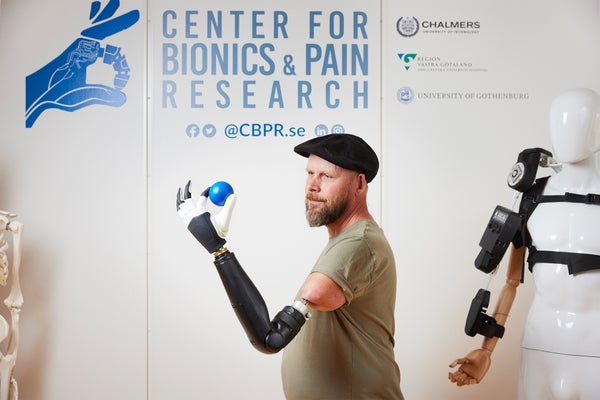
Most bionic limbs are controlled by electrical signals generated by muscles moving near the attachment site. But when an arm is amputated above the elbow, the remaining muscles aren't enough to control every joint in an artificial hand. “The higher the amputation, the more joints you have to replace, and the fewer muscles you have to do it,” says Max Ortiz Catalán, a bionicist at Chalmers University of Technology in Sweden.
Now Ortiz Catalán's team has developed a bionic system that allowed a man with an above-elbow amputation to control every finger of a robotic arm, as described recently in Science Translational Medicine. To create more muscle signals to prompt the prosthetic, the researchers dissected the nerve bundles that carry signals from the man's brain to muscles in his upper arm. The fibers were then spread out and attached to new muscle targets in his remaining arm, including muscle tissue grafted from his thigh. They also anchored a titanium fixture into the remaining upper-arm bone, making the prosthesis more comfortable than typical fitted socket attachments.
Prosthetics usually pick up muscle signals with electrodes on the skin's surface. For the new device, the researchers used a more reliable technique: implanting electrodes directly on or within the muscles. This commonly involves running wires through the skin—a design feasible only in laboratory settings, not in daily life. But in the new system, wires pass through the titanium bolt and into the robotic arm. A processor in the prosthesis then uses an artificial-intelligence algorithm to translate the muscle signals into control signals for joints in the arm and hand.
On supporting science journalism
If you're enjoying this article, consider supporting our award-winning journalism by subscribing. By purchasing a subscription you are helping to ensure the future of impactful stories about the discoveries and ideas shaping our world today.
The man has been using the prosthesis in his daily life for more than three years to grasp objects and pour drinks. “This is the first nerve-based prosthetic hand that the patient can go home with,” says bioengineer Cynthia Chestek of the University of Michigan, who was not involved in the project. The team is working to optimize the controllability of the prosthesis and to integrate sensory feedback.
Still, attaching the device requires major surgery that carries a risk of infection. “Not all amputees are going to want a titanium bolt through their skin,” Chestek says. Also, the prosthesis has so far been demonstrated just once. “It's only one participant, but it shows some exciting results,” says prosthetic scientist Laura Miller of the Shirley Ryan AbilityLab in Chicago. Her group is planning to collaborate with Ortiz Catalán on a larger trial. “We're excited to do this type of procedure with more people,” she says.