
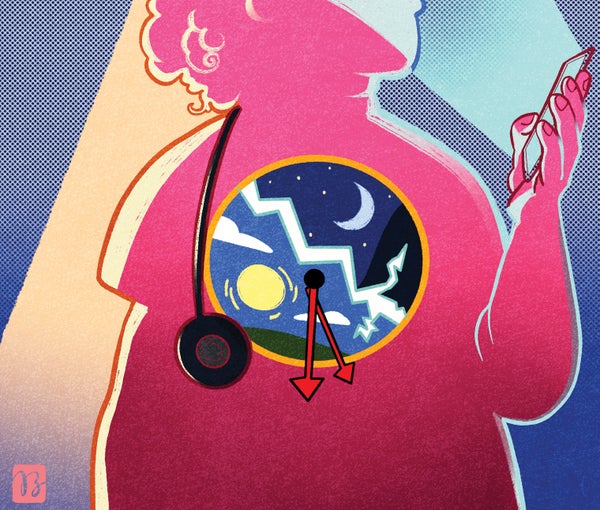
I usually get up by 7 A.M. and am in bed by 10 P.M. I tend to eat meals at the same times of day, too. This may sound a little dull, but it's essential for my productivity. It's also a schedule that rarely disrupts my body clock. And a steady clock, it turns out, just might help me and many other people avoid cancer and some other diseases, according to new research.
What I call a body clock really means circadian rhythms, from the Latin for “about” and “day.” These are the body's internal biological pacemakers, physiological fluctuations that help us adjust to the phases of a 24-hour day by synchronizing with environmental cues such as light, dark, temperature and food intake. These rhythms affect sleeping and waking, feeding and fasting, endocrine cycles, immune function, and cell growth.
For some time now epidemiological studies of night-shift workers have linked disruptions in circadian rhythms to cancer and other diseases. Much of the evidence concerned breast cancer and to a lesser extent prostate cancer. Duration of shift work made a difference—nurses who worked night shifts for up to 30 years were at moderately increased risk for breast cancer compared with those who did shorter stints, and those who worked such shifts for more than 30 years had the highest risk. In 2019 the World Health Organization reaffirmed and updated a research statement from the agency showing that shift work is a probable carcinogen.
On supporting science journalism
If you're enjoying this article, consider supporting our award-winning journalism by subscribing. By purchasing a subscription you are helping to ensure the future of impactful stories about the discoveries and ideas shaping our world today.
Now there is even more evidence involving other types of malignancies, including liver, lung and colorectal cancers, from a spate of new studies. “We're starting to understand the reasons these things happen,” says Selma Masri, a circadian biologist at the University of California, Irvine, who has shown how circadian disruption pushes colon cancer progression by interfering with the way certain genes are expressed.
The cancer connection comes about through several mechanisms. Circadian disruption affects metabolic pathways, the chemical reactions that produce energy in the body. It tampers with immune function. It also compromises the fidelity of DNA repair in cells. Adult human cells divide every 18 to 24 hours, and one function of the circadian clock is to tell cells to do that at night to avoid DNA damage from sunlight. “When the clock gets disrupted, cells don't know when to divide,” says circadian biologist Satchidananda Panda of the Salk Institute for Biological Studies. “They can divide faster and become a tumor.”
Circadian disruption doesn't only occur in shift workers. It happens when we consistently don't get a good night's sleep—scientists say this can mean waking up for two or three hours between 10 P.M. and 5 A.M. at least once a week. Wakeful episodes can be caused by jet lag, staying out late, or looking at blue-light-emitting phone screens—which mimic daylight—at night. When and what we eat also cues our rhythms, just as light and dark do, so add snacking at midnight to the list of things to avoid.
The growing understanding of circadian rhythms also could offer help through what's known as chronotherapy. Certain chemotherapy treatments, for example, are more effective when given in accordance with a patient's rhythms. Now researchers are exploring differences in the timing of radiation therapy. Drugs that bolster natural rhythms are also under investigation.
Shift work is critical and not going away, says Katja Lamia, a circadian biologist at Scripps Research, but there might be ways of reducing its toll on the body. Her research suggests that subtle increases in body temperature might be an important factor in circadian disruption. If that turns out to be right, Lamia says, “we can use noninvasive monitoring of body temperature in shift workers to evaluate who's at risk and take a personalized scheduling approach.”
For those who don't work at night, changing some routines might be enough. A good night's sleep should be a priority. Eating habits can also play a role. Panda and his colleagues are investigating a practice known as time restricted eating (TRE) or intermittent fasting. That might mean delaying breakfast by an hour or two until cortisol levels drop and eating dinner at least three hours before your habitual bedtime. In a 12-week study of firefighters, TRE benefited their metabolic health and improved their sleep. In mice, it has been shown to reduce the risk of cancer or to slow the growth of tumors.
Maybe, Panda says, respecting our circadian rhythms can help protect our time-sensitive bodies.