
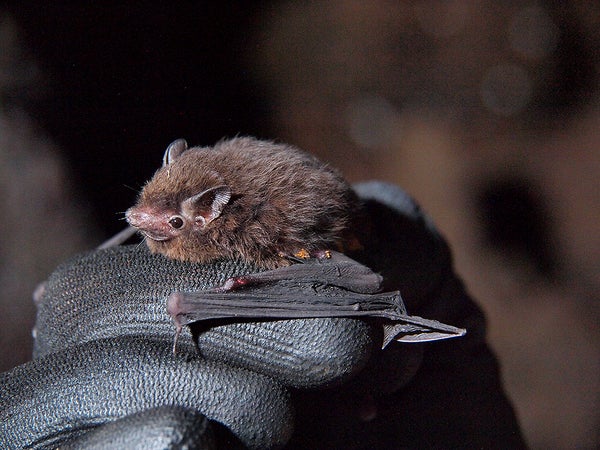
Guided by local villagers, the bat biologists descended into the mouth of a cave on Fiji’s remote island of Vanua Balavu. They slipped down a rock face, swam through an underground pool, clambered over piles of guano and emerged into a cathedral-sized cavern “absolutely chockablock-full” of Pacific sheath-tailed bats, says Kris Helgen, a mammal expert and chief scientist at the Australian Museum Research Institute in Sydney.
Thousands of the animals filled the cave like a cloud, and Helgen could feel the whoosh of their delicate wings as they zoomed around him in the dark. “It was a breathtaking moment,” he says.
The April expedition, led by the nonprofit organization Conservation International, had not only discovered the largest known bat cave in the Pacific Islands, with a population conservatively estimated at 2,000 to 3,000; the researchers had also found new hope for a creature they’d feared was racing toward extinction.
On supporting science journalism
If you're enjoying this article, consider supporting our award-winning journalism by subscribing. By purchasing a subscription you are helping to ensure the future of impactful stories about the discoveries and ideas shaping our world today.
Pacific sheath-tailed bats have soft, chocolate-brown fur and reach just five grams—the weight of a nickel or a sheet of paper. A few million years before humans sailed across the Pacific and made their homes on island after island, these tiny bats undertook the same astonishing journeys—by air. (A related species, the slightly larger Brazilian free-tailed bat, can fly 160 kilometers in a single night.)
The Pacific Islands have 191 known bat species, from tiny insectivorous microbats such as the four-centimeter-long sheath-tailed bats to fruit-eating flying foxes that dangle in trees and have a wingspan of a meter. People in the region collect bats’ guano for fertilizer, hunt them for food and—in the Solomon Islands—even use their teeth as traditional currency.
Sheath-tailed bats were once among the Pacific’s most widespread mammals but are now one of its most threatened. Less than a century ago they were found across Oceania, from Guam to American Samoa. Today the four recognized subspecies are now thought to survive on just a few Micronesian and Fijian islands.
The archipelagic nation of Fiji is the “last stronghold” of the sheath-tailed subspecies Emballonura semicaudata semicaudata, says expedition member Siteri Tikoca, a Fijian conservation biologist and a Ph.D. candidate at the University of Adelaide in Australia. But in Fiji, too, the bat’s populations have been plummeting.
Some important roosts are now completely devoid of bats. Tikoca says she counted around 1,000 sheath-tailed bats in 2018 in a cave on the island of Taveuni, roughly 120 km northwest of Vanua Balavu. By 2019, the forests had been cleared almost to the mouth of that cave—and just a few hundred bats remained.
Tikoca says finding such a healthy roost in the Vanua Balavu cave was a “beautiful” moment that rekindled her hope for these bats. But the Taveuni situation “emphasizes the need to protect them now because so much can happen within a span of one year,” she says. “If we don't do anything for it in Fiji, then we will lose this subspecies entirely.”
Conservation International says it will now work with the area’s Indigenous communities to better safeguard the cave. “We’re all the richer for the fact that they have looked after those landscapes, those caves and ultimately those bats,” Helgen says.
The insectivorous bats are thought to play a key role in the surrounding ecosystems, eating crop pests and controlling disease-bearing mosquitoes. Learning more about these creatures’ ecology is critical, Tikoca says, and is a crucial first step toward potentially relocating sheath-tailed bats to some of their former haunts.
“This is such an impressive find and a massive win for the species,” says Jon Flanders of Bat Conservation International, who was not involved in the expedition. Worldwide, 270 new bat species have been described since 2005, he says—and this latest discovery suggests other Pacific islands may shelter yet more winged surprises. “It just goes to show how little we still know about bats,” he says.