
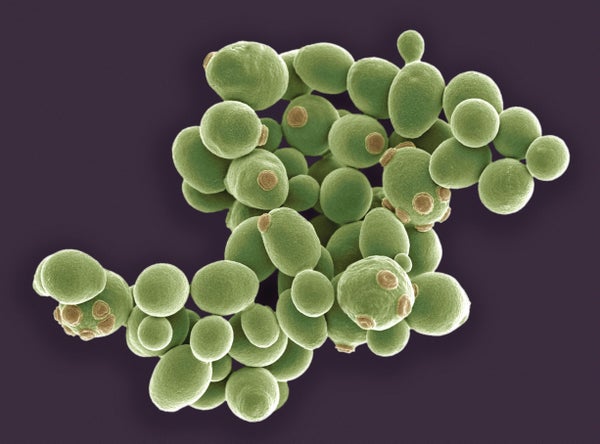
When brewer’s yeast left over from beer making is mixed with the right seasonings, it makes a bitter, earthy paste called Marmite that is especially popular in the U.K. Smeared on toast, it’s a snack that can be an acquired taste. But a study published recently in Frontiers in Bioengineering and Biotechnology found that residual yeast sludge can also be used to bind to electronic-waste metals—a capability the research suggests could help recycle the world’s growing mountains of discarded gadgets.
When the study authors added brewer’s yeast, a single-cell fungus, to a watery solution of mixed metals, they noticed the yeast could isolate and take up specific metals—and be reused at least five times without losing binding strength. The team says this method offers a more environmentally sustainable alternative to current extraction techniques such as pyrometallurgy, an energy-intensive melting process that can release toxic fumes. And even though brewer’s yeast may be tasty to some, much of it still gets dumped, and it is extremely cheap and plentiful.
“In Austria, we produce a lot of beer and have a lot of brewer’s yeast that goes to waste,” says study lead author Anna Sieber, a graduate student at the University of Natural Resources and Life Sciences in Vienna. Knowing the yeast can bind to metals and be used multiple times, she says, “we think this method could actually help limit both the yeast and electronic-waste streams.”
On supporting science journalism
If you're enjoying this article, consider supporting our award-winning journalism by subscribing. By purchasing a subscription you are helping to ensure the future of impactful stories about the discoveries and ideas shaping our world today.
The researchers rinsed, froze, dried and ground up 20 liters of residue with inactive yeast from a brewery. Next they added some of the yeast to solutions containing a laboratory-made mix of aluminum, copper, nickel and zinc, then added some to solutions with those same metals leached directly from scrapped printed circuit boards. The researchers adjusted the mixtures’ acidity and temperature to alter the charge of sugar molecules on the yeast organisms’ surfaces; particular metals are drawn to specific charges on the sugars, so this process controlled which metals the yeast attracted and bound. After each attempt, the scientists extracted the yeast and soaked it in an acid bath to remove the metals from it, leaving the yeast ready for another round.
The four tested metals are relatively inexpensive, and most e-waste recyclers currently prioritize recovering more valuable ones such as gold, silver and platinum. But the study’s metals are still beneficial and widely used—which “justifies the recycling process,” says Treavor Boyer, an environmental engineer at Arizona State University. Kerry Bloom, a biologist at the University of North Carolina at Chapel Hill, adds that the yeast’s low price and sheer abundance could make the technique relatively feasible at a large scale if e-waste recycling facilities prove willing to invest in something new. “There are huge vats of yeast that often have nowhere to go once brewers are done with them,” he says. “So this is a fantastic source for it. It’s the master recycler.”