New Issue: Orbital Catastrophe Ahead? Read Now

Aging’s True Tactics

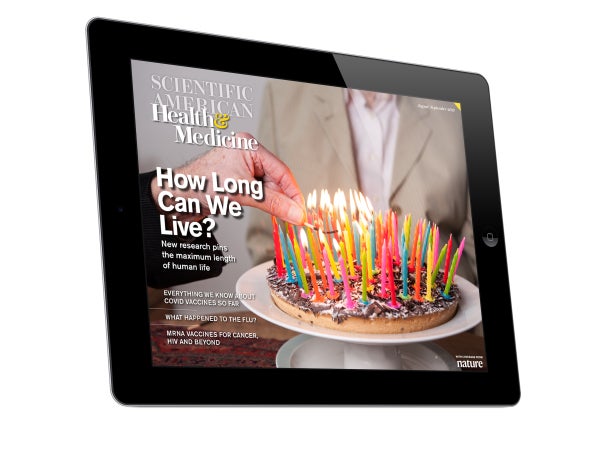
New research pins the maximum length of human life

Credit: Scientific American Health & Medicine, Vol. 3, Issue No. 4

Join Our Community of Science Lovers!


On supporting science journalism

If you're enjoying this article, consider supporting our award-winning journalism by subscribing. By purchasing a subscription you are helping to ensure the future of impactful stories about the discoveries and ideas shaping our world today.


For many cultures, including the U.S. and China, aging is a particular anathema. The global market for antiaging products alone is valued at more than $50 billion a year and is expected to balloon to more than $83 billion in less than a decade. The demand to slow aging—through mostly ineffectual pills, serums or creams--is real. But our understanding of how the human body ages is still nascent, one could argue. In fascinating new findings, a team of researchers determined that an ultimate limit to human life exists, mostly because the body’s ability to bounce back from disease or other disruptions and reestablish a so-called equilibrium declines over time. So aging may be less about how quickly the body degrades and more about the body’s overall resilience (see “Humans Could Live up to 150 Years, New Research Suggests”).

For now one of the biggest threats to human life remains the COVID-19 pandemic. With nearly two billion doses administered, Nature reporter Heidi Ledford profiles everything we have learned so far about these new medicines (see “Six Months of COVID Vaccines: What 1.7 Billion Doses Have Taught Scientists”). And mRNA technology may open the door for new treatments against an array of diseases beyond COVID, including cancer (see “After COVID-19 Successes, Researchers Push to Develop mRNA Vaccines for Other Diseases”). Here’s to your long and healthy life.

Andrea Gawrylewski is chief newsletter editor at Scientific American. She writes the daily Today in Science newsletter and oversees all other newsletters at the magazine. In addition, she manages all special editions and in the past was the editor for Scientific American Mind, Scientific American Space & Physics and Scientific American Health & Medicine. Gawrylewski got her start in journalism at the Scientist magazine, where she was a features writer and editor for "hot" research papers in the life sciences. She spent more than six years in educational publishing, editing books for higher education in biology, environmental science and nutrition. She holds a master's degree in earth science and a master's degree in journalism, both from Columbia University, home of the Pulitzer Prize.

More by Andrea Gawrylewski
SA Health & Medicine Vol 3 Issue 4This article was published with the title “Aging's True Tactics” in SA Health & Medicine Vol. 3 No. 4 ()
doi:10.1038/scientificamerican082021-iYwm3T28aET41AGeQdF5J

Subscribe to Support Independent Journalism

Great science journalism requires human expertise, time, effort and creativity. And it costs money. That’s why I and the journalists here at Scientific American hope you’ll join our community.

When you subscribe, you are supporting staff and freelance journalists who are passionate about telling science stories that are true, important and compelling. Our editors and reporters are often experts in their fields, which means they understand the nuances of big discoveries and can untangle the breakthroughs from the hype. With a subscription, you are also supporting rigorous fact-checking to ensure the words we publish are precise and accurate. And you’re supporting original illustrations, graphics and photos that bring you closer to an advanced laboratory, an ice sheet in Antarctica or a space mission in orbit. You’re helping us craft other types of high-quality journalism as well: Our newsletters are carefully written, edited and curated by staffers you have or will come to know and love. Our Science Quickly podcast is based on original reporting, collaboration with editors and scientists and exacting production.

Subscriptions keep this engine running so we can continue to deliver thoughtful, rigorous and independent science journalism to you. In an era of viral misinformation, this work is crucial. If you value what we do, I hope you’ll consider joining us as a subscriber

Thank you,

Jeanna Bryner, Editor in Chief, Scientific American

Subscribe