
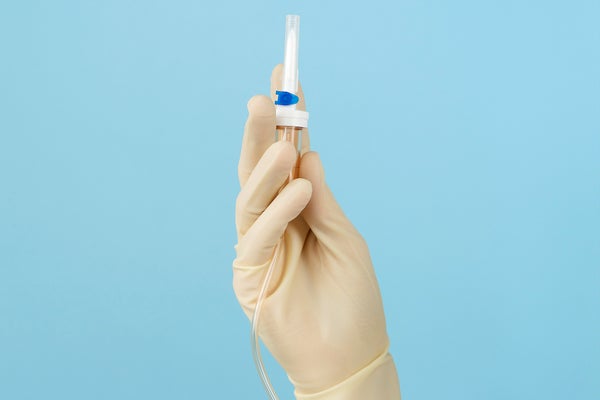
More than 100 million urinary catheters are placed every year, and the devices can be lifesaving, especially after surgery. But many of those who use them—about a quarter of users in developing countries and about an eighth in the U.S.—develop a catheter-associated urinary tract infection (CAUTI), commonly caused by bacteria building up inside the tube.
Researchers aided by artificial intelligence have now designed a new catheter they say could reduce bacterial contamination by up to two orders of magnitude—without antibiotics. Its interior is studded with three-dimensional geometric shapes that help to prevent bacteria from gaining traction and making it to the bladder.
“In a normal catheter, there is no physical shape inside,” says computer scientist Animashree Anandkumar, co-author of the new study in Science Advances. This leaves a smooth highway for bacteria to work their way up from the outside and colonize the inner surface. When colonies build up in the catheter near the bladder, they can enter the urinary tract and lead to a CAUTI.
On supporting science journalism
If you're enjoying this article, consider supporting our award-winning journalism by subscribing. By purchasing a subscription you are helping to ensure the future of impactful stories about the discoveries and ideas shaping our world today.
In the past doctors have sometimes coated catheters’ interior walls with antibiotic drugs or metallic agents such as silver to kill bacteria. But such methods can be expensive—and increasingly ineffective as antibiotic-resistant bacteria become more prevalent. The new device does not rely on a specialized coating to repel microbes; simple geometry does the trick. A series of tiny, 3-D—printed ridges shaped like sharp triangles line the inside of the catheter, forming a kind of obstacle course for the bacteria. As the microbes try to swim upstream, they bump and tumble into the ridges, eventually halting or bouncing back down. The design could help reduce expensive and unnecessary antibiotics and could prolong the amount of time a catheter can be used," the researchers say.

To find the perfect bacteria-repelling labyrinth, Anandkumar and her team used AI to quickly run digitally modeled catheters through tens of thousands of simulations. Once they landed on a design that best blocked virtual bacteria under multiple scenarios in the computer model, they 3-D printed a prototype and tested it in the laboratory with a broth containing Escherichia coli bacteria. After 24 hours, the experimental device had built up less than one one-hundredth of the bacterial colonies in a traditional catheter that the researchers 3-D printed and tested alongside it.
“These are pretty exciting results,” says Glenn Werneburg, a Cleveland Clinic urologist who was not involved in the study. He notes that the new catheter is currently optimized to resist E. coli—one of the most common microbes associated with CAUTIs—but other species are also known to colonize catheters and cause infection. “Bacteria on catheters are present as biofilms, and we know that different species of bacteria behave in different ways,” Werneburg says. A modified future design would ideally be inaccessible to other microbes, such as Enterococcus and Proteus bacteria, he adds. Anandkumar agrees, and she says that accurately modeling such designs may require further research and more data about these microbes’ properties. The scientists will also need to test their AI-modeled design in a clinical setting before it can be widely produced.
Anandkumar says such modeling has potential far beyond catheters: she hopes to harness AI to help design drugs, energy-efficient airplane propellers, and more. “To me,” she says, “this is just the beginning.”