
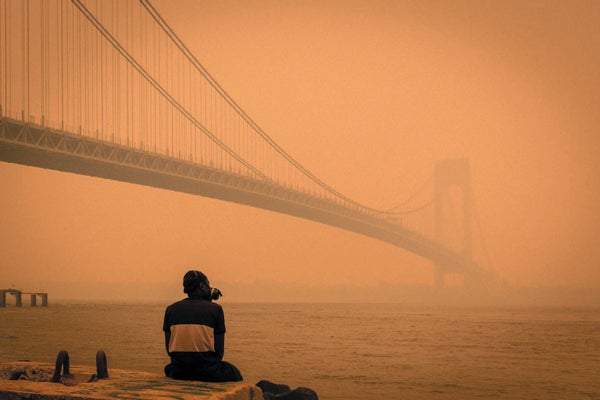
Air pollution is one of the world's greatest public health threats, reducing global life expectancy more than smoking, alcohol or childhood malnutrition. Recent studies estimate that fine particulate matter called PM2.5—pumped out by cars, factories, woodstoves and wildfires—causes nearly nine millionpremature deaths annually, with South Asia bearing the highest tolls.
PM2.5 particles are tiny enough to enter the bloodstream and lodge in the lungs, where they contribute to respiratory problems such as asthma. They also can prompt heart attacks and strokes. And they have been linked to diabetes, obesity and dementia and may exacerbate COVID. As several recent studies demonstrate, the consequences of dirty air don't stop there. “We are finding out that particulate matter affects almost every aspect of our bodies and minds, from cognition to our heartbeats to our skin,” says Christa Hasenkopf, an air-quality data expert at the University of Chicago. Though not involved in the three studies highlighted here, Hasenkopf expresses no surprise at the results, which “underscore literally thousands of other studies that show similar conclusions.”
CANCER
On supporting science journalism
If you're enjoying this article, consider supporting our award-winning journalism by subscribing. By purchasing a subscription you are helping to ensure the future of impactful stories about the discoveries and ideas shaping our world today.
Living near high-traffic roadways or other areas rife with PM2.5increases the risk of breast cancer by about 8 percent, according to a study that examined 15,870 breast cancer patients in six U.S. states and two cities. Lead author Alexandra White, an epidemiologist at the National Institute of Environmental Health Sciences, speculates that airborne pollutants make people more susceptible to breast cancer by disrupting “the normal hormonal mechanisms in our bodies.” White is also studying air pollution's impact on gynecological cancers, and other researchers have tied it to liver, pancreatic, prostate, lung and ovarian cancers, among others.
SMALLER BABIES
Along with the elderly and already ill, babies tend to suffer the most from air pollution; it has been shown to impair their lungs, their immune responses and even their size. Women in northern Europe exposed to PM2.5 and other air pollutants give birth to smaller babies, according to findings that Robin Mzati Sinsamala, an epidemiologist at Norway's University of Bergen, presented recently at a European Respiratory Society conference. Fine particles can penetrate the placenta and affect the “exchange of oxygen and nutrients between the baby and the mother,” Sinsamala says, noting that infants with low birth weights face many health risks.
SUICIDE
In the U.S., smoke from increasingly large and frequent wildfires impacts more than just physical health. David Molitor, an associate professor of finance at the University of Illinois at Urbana-Champaign, and his colleagues have found that the number of suicides ticks up in rural U.S. counties (though not urban ones) on smoky days. “It adds a little extra stress,” Molitor says, “and sometimes that's all that's needed if you're in a vulnerable position to begin with.”
IF YOU NEED HELP
If you or someone you know is struggling or having thoughts of suicide, help is available. Call or text the 988 Suicide & Crisis Lifeline at 988 or use the online Lifeline Chat.