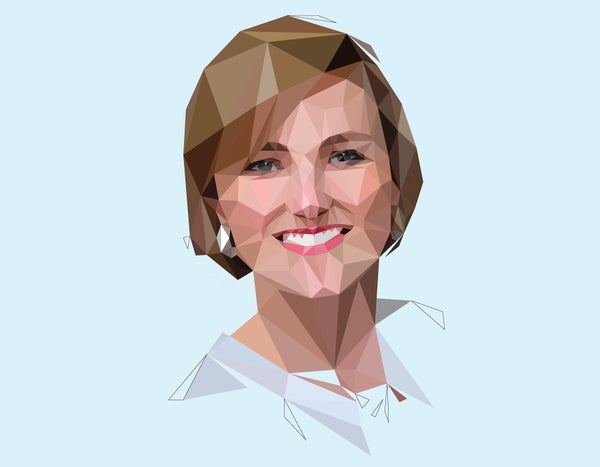
Alice Stanton’s friends call her a brain engineer. It’s an apt title for the scientist who developed the first complete tissue model of the human brain, with blood vessels and all six major cell types, including neurons and immune cells. She also has created a brain-on-a-chip, a version of her full-size model that’s smaller than a mustard seed. Stanton wants to use these mini brains to better understand neurological diseases such as Alzheimer’s and Parkinson’s so researchers can develop personalized treatments for them.
Stanton grew up in Erie, Pa., exploring nature and biology by playing in the sand and collecting insects. When she was young, she watched her grandmother cope after a stroke. “I think that started my fascination with the brain and my desire to devote my life to coming up with as many new therapeutic possibilities as I could,” she says.
On supporting science journalism
If you're enjoying this article, consider supporting our award-winning journalism by subscribing. By purchasing a subscription you are helping to ensure the future of impactful stories about the discoveries and ideas shaping our world today.

Tony Luong
Stanton built her brain model, called miBrain, at the Massachusetts Institute of Technology, using techniques she had gleaned from working with stem cells earlier in her career. To model neurological diseases, she incorporated other types of cells, including immune cells called microglia; overactive microglia drive chronic inflammation, which is tied to Alzheimer’s. From this larger model, Stanton developed a miniature version—a brain-on-a-chip—that can be used to test therapeutics.
Organs-on-a-chip are emerging as tools of great potential in research and drug discovery. But the road to effective treatments is long and bumpy, and recent cuts to federal funding for science could threaten progress. Having stable support is incredibly important for momentum, Stanton says. “When we have a loved one who gets sick, we want a treatment—we want something to cure them,” she says. “It doesn’t come out of thin air.”
This article is part of “The Young American Scientists,” an editorially independent project that was produced with financial support from Regeneron. Special thanks to the Museum of Science in Boston, where Stanton's portrait and video interview were captured.