New Issue: Orbital Catastrophe Ahead? Read Now

All Sand on Earth Could Be Made of Star Stuff

Silica, a common ingredient in sand, concrete and glass, may have its origins in supernovae

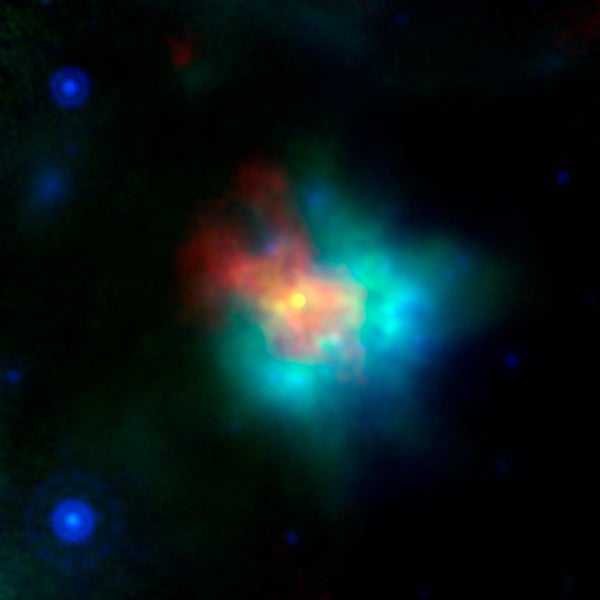
Supernova remnant G54.1+0.3.

NASA, JPL-CALTECH, CXC, ESA, NRAO, J. RHO and SETI Institute

Join Our Community of Science Lovers!

Astronomers have long argued that the phrase “we are stardust” is more than poetic language. Now new evidence adds another stanza to this great cosmic verse. 

Dust from silica—a common component of Earth’s core, sandy beaches, concrete, glass and even cell phones—has been detected within the remnants of two supernovae in the Milky Way galaxy. These observations, described last October in Monthly Notices of the Royal Astronomical Society, provide the first evidence that silica originated within exploding stars. 

“This is a rich result in that something so common on Earth has now been found to be created in the most violent explosions in the universe,” says study co-author Haley Gomez, an astronomer at Cardiff University in Wales. “It’s an origin story.” 


On supporting science journalism

If you're enjoying this article, consider supporting our award-winning journalism by subscribing. By purchasing a subscription you are helping to ensure the future of impactful stories about the discoveries and ideas shaping our world today.


Astronomers have long pondered how cosmic dust—whether it is composed of, say, silica, carbon or iron—is created. Initially they thought it formed when sunlike stars reached old age and threw off mighty winds, whose gases were thought to condense into solid dust grains just as snowflakes form in a chilly atmosphere. But when observers detected dust in galaxies so distant that they must have formed soon after the big bang—well before sunlike stars could have evolved—they knew there must be another source. 

They started to suspect that dust appeared within supernovae explosions soon after the universe formed, but astronomers have only recently detected a handful of nearby supernovae remnants sprinkled with dust. And Mikako Matsuura, an astronomer who is also at Cardiff but was not involved in the study, says she is excited to see further evidence. 

If the dust within these early-universe supernova remnants is also found to contain silica, the first planets might have looked similar to our own pale-blue dot. “It’s really interesting to know we can make planets like Earth so soon” in the universe’s existence, Gomez says. “It doesn’t take 13 billion years.”

Shannon Hall is an award-winning freelance science journalist based in the Rocky Mountains. She specializes in writing about astronomy, geology and the environment.

More by Shannon Hall
Scientific American Magazine Vol 320 Issue 2This article was published with the title “Sand from Stardust” in Scientific American Magazine Vol. 320 No. 2 (), p. 17
doi:10.1038/scientificamerican0219-17

Subscribe to Support Independent Journalism

Great science journalism requires human expertise, time, effort and creativity. And it costs money. That’s why I and the journalists here at Scientific American hope you’ll join our community.

When you subscribe, you are supporting staff and freelance journalists who are passionate about telling science stories that are true, important and compelling. Our editors and reporters are often experts in their fields, which means they understand the nuances of big discoveries and can untangle the breakthroughs from the hype. With a subscription, you are also supporting rigorous fact-checking to ensure the words we publish are precise and accurate. And you’re supporting original illustrations, graphics and photos that bring you closer to an advanced laboratory, an ice sheet in Antarctica or a space mission in orbit. You’re helping us craft other types of high-quality journalism as well: Our newsletters are carefully written, edited and curated by staffers you have or will come to know and love. Our Science Quickly podcast is based on original reporting, collaboration with editors and scientists and exacting production.

Subscriptions keep this engine running so we can continue to deliver thoughtful, rigorous and independent science journalism to you. In an era of viral misinformation, this work is crucial. If you value what we do, I hope you’ll consider joining us as a subscriber

Thank you,

Jeanna Bryner, Editor in Chief, Scientific American

Subscribe