
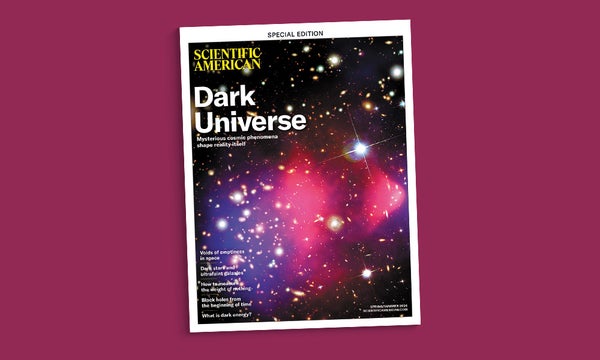
Humans have always looked to the stars. Those pinpricks of light in the vast blackness spark curiosity, wonder and awe. Our newest orbiting observatory, the James Webb Space Telescope (JWST), launched in 2021 and is sending back jaw-dropping images of visible and infrared light from galaxies, star-nursery nebulas and supermassive stars. More than 25 years ago astrophysicists discovered that rather than slowing down as it expands, the universe is in fact speeding up; some invisible force between the points and clusters of light is making the universe careen off in every direction. The cosmos is brimming with this so-called dark energy and other mysterious phenomena.
The empty vacuum of space is alive with exotic particles flashing in and out of existence. Some of them—whether so-called WIMPs, axions, or other, as yet undiscovered particles—may be the invisible dark matter pulling galaxies together. Some stars might be fueled by the annihilation of dark matter itself.
There are sprawling voids in space, some hundreds of millions of light-years across, whose emptiness scientists think is the ideal zone for studying less understood particles such as neutrinos. Some galaxies are made primarily of dark matter and contain very few stars. Stranger still, earlier this year astronomers reported the discovery of a galaxy emitting a radio signal but hardly any visible light.
On supporting science journalism
If you're enjoying this article, consider supporting our award-winning journalism by subscribing. By purchasing a subscription you are helping to ensure the future of impactful stories about the discoveries and ideas shaping our world today.
The darkest places we know of are undoubtedly black holes. Their gravitational hearts devour all light, and scientists suspect that the space inside black holes is stretchy and could grow forever or connect to other black holes through wormholes in spacetime. The existence of black holes was first hypothesized by Albert Einstein, but it took a century to capture an image of one, and even that image is of just the fiery ring of matter wrapping around the penumbra of the event horizon—the black hole remains faceless.
The explanations for these dark phenomena may be found in points of light. JWST has spotted bulky galaxies from the early days after the big bang. Their existence could signal a potential alternative way for black holes to form.
One of the more mind-bending hypotheses in cosmology is that our universe could be a holographic projection of a lower dimension. This concept has led to new ideas about black holes and the early universe. Spacetime itself may not be an inherent feature of the universe; instead it could arise from a more basic framework of the cosmos. And Nobel Prize–winning physicists have shown that our reality is not necessarily ... real.
Humans peer at the stars, yes, but we are limited by our eyes, perceiving only 0.0035 percent of the electromagnetic spectrum. We can’t see radio waves, x-rays or heat, never mind other forces such as gravity or magnetism, but innovative technology is allowing us to understand some of the unseen. The totality is mostly still hidden from us in darkness, but that doesn’t mean we’ll stop looking.