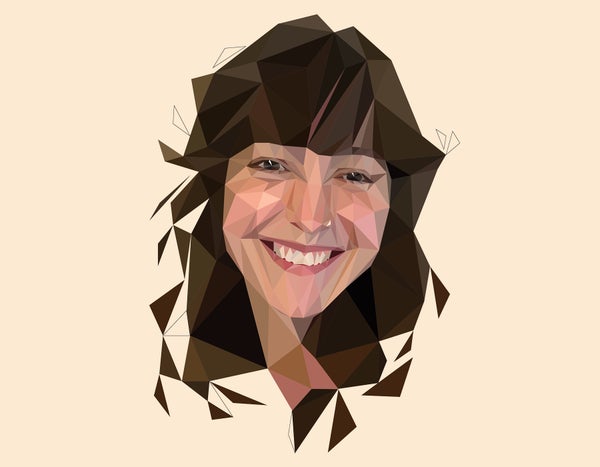
Allie Balter-Kennedy goes to some of the harshest places on Earth to try to predict how a warming climate will impact the planet’s ice sheets. The Tufts University scientist works with a team, sometimes drilling hundreds of feet down into the ice, to explore changes that have occurred over thousands, even millions of years. The history of Earth that is hidden in the cores helps her foresee its future.
To study the cores, she uses a method called cosmogenic-nuclide exposure dating, which exploits the fact that Earth is constantly bombarded with cosmic rays made up of charged particles. Those particles interact with atoms in our atmosphere and on the planet’s surface, creating isotopes. By measuring the levels of isotopes in long-buried core samples, scientists can estimate how long it’s been since that rock was exposed to the atmosphere. And knowing when the land was last ice-free can help scientists better understand what climate processes were going on at the time.
On supporting science journalism
If you're enjoying this article, consider supporting our award-winning journalism by subscribing. By purchasing a subscription you are helping to ensure the future of impactful stories about the discoveries and ideas shaping our world today.

Tony Luong
Balter-Kennedy’s work has taken her to Antarctica and to the Arctic, including Greenland, where she spends weeks at a time living in a tent on the ice sheet—a challenging environment but one Balter-Kennedy relishes. “The aspect of getting to be outside and work in remote places and the collaborative nature of all this fieldwork are essentially what drew me to this field in the first place,” she explains.
Balter-Kennedy hadn’t always planned on a life in academia. These days she is getting a crash course in the more administrative side of being an early-career academic—applying for grants, teaching undergraduates and recruiting people to work in her laboratory. But in the meantime, she is driven by her central questions of what climate change will bring and what she may find in the depths of the planet’s ice.
This article is part of “The Young American Scientists,” an editorially independent project that was produced with financial support from Regeneron. Special thanks to the Museum of Science in Boston, where Balter-Kennedy's portrait and video interview were captured.