
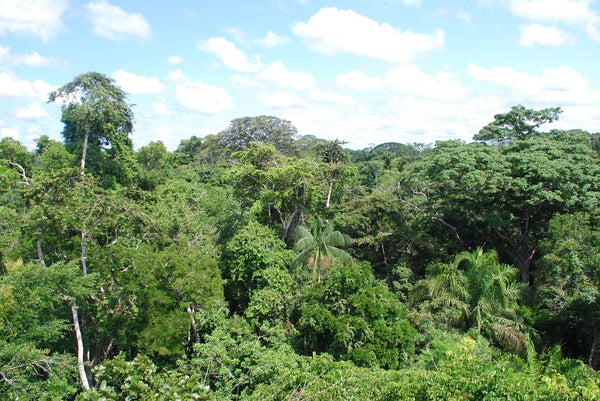
The Amazon has long been held up as an example of untamed wilderness. But people have lived in the world’s largest rainforest for thousands of years, hunting, gathering and farming. For years, researchers have debated how much of an influence human activities have had on the Amazon. And now, a study describes the extent to which ancient peoples changed the distribution of trees in the forest around them.
The paper, published on March 2 in Science, finds that many domesticated trees and palms are five times more likely to be over-represented in the Amazon than are non-domesticated ones. The researchers also found that the domesticated plants tended to cluster around the remains of pre-Columbian settlements—or areas where people lived prior to the arrival of Christopher Columbus. They suggest that this pattern could help other scientists to discover as yet unknown ancient settlements in the Amazon.
“It’s not enough to study the environmental conditions that structure these communities of trees and palms,” says Carolina Levis, a palaeoecologist at Wageningen University in the Netherlands and the lead author of the study. “We need to ask ‘what are the human influences in these communities?’”
On supporting science journalism
If you're enjoying this article, consider supporting our award-winning journalism by subscribing. By purchasing a subscription you are helping to ensure the future of impactful stories about the discoveries and ideas shaping our world today.
A cornucopia
Levis and her team used data from the Amazon Tree Diversity Network—a group of researchers who share information on palms and trees in the Amazon—to estimate biodiversity in the rainforest. So far, scientists in the network have identified 4,962 palm and tree species in the Amazon. Of the 85 domesticated woody species, Levis discovered that about 20 of them, such as Brazil nuts (Bertholletia excelsa) and cocoa plants (Theobroma cacao), were over-represented.
The researchers wanted to know whether this was because of human influence or the environment. So they compared the distribution of domesticated species to more than 3,000 known pre-Columbian archaeological sites and likely settlement areas, including near the banks of rivers. Domesticated species were much more likely to thrive where ancient people had lived than were non-domesticated species.
All told, about 20% of the distribution of domesticated species across the Amazon seemed to be driven by human influences, while 30% was likely due to environmental factors such as soil composition. However, in the southwestern Amazon—which hosted large pre-Columbian populations—about 30% of the distribution of domesticated species stemmed from human activities. Less than 10% was due to environmental conditions.
Old versus new
This doesn’t necessarily mean that ancient human actions were solely responsible for the distribution of domesticated plants, cautions Crystal McMichael, a palaeoecologist at the University of Amsterdam. “It’s quite well known that ancient people and modern people both settle in similar areas.” So it’s possible that more modern groups influenced the ecosystems we see today as much as ancient ones, she adds.
Human actions could also have created conditions that favoured domesticated plants over their wild brethren, says Mark Bush, an ecologist at the Florida Institute of Technology in Melbourne. And the domesticated species could re-colonize disturbed areas more easily than non-domesticated ones without any help from people.
When people abandoned Mayan sites in Central America, Brosimum trees re-colonized the area. But for years, researchers thought the Mayans had planted them deliberately. Levis and her team could be observing a similar phenomenon, Bush says.
Levis acknowledges that their study didn’t separate out the effects of modern peoples from their ancestors. But Bush and McMichael agree that irrespective of the cause, the distribution of plants in the Amazon follows modern and ancient human settlements. Levis and McMichael are in the process of developing a model to use that pattern to find areas where people may have lived thousands of years ago.
Ultimately, says Levis, this research shows that the Amazon is not an untamed jungle, but an ecosystem that humans have been a part of for ages, and their actions have left their mark on the land.
“People want to preserve pristine forests for conservation and to preserve life,” she says. “But if this is true, if people enriched the forests by domesticating palms, that is also a cultural artefact.” The trees that live in these populated areas may be relics of a vibrant past.
This article is reproduced with permission and was first published on March 2, 2017.