
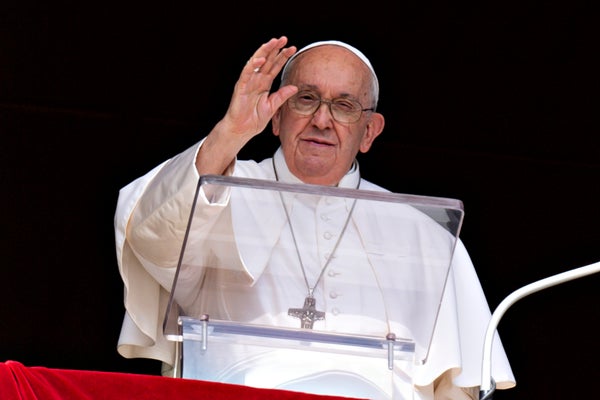
CLIMATEWIRE | Some American Catholics are calling for climate action after Pope Francis’ latest encyclical, which singled out the United States as the world’s biggest emitter of planet-warming emissions.
The pope's Oct. 4 message — called "Laudate Deum," or "Praise God" — is an update to his landmark 2015 encyclical on the environment. It asserts that emissions per person in the U.S. are “about two times greater than those of individuals living in China, and about seven times greater than the average of the poorest countries.”
“We can state that a broad change in the irresponsible lifestyle connected with the Western model would have a significant long-term impact," the pope wrote in the 17-page document. He called for political decisions on climate change that would make progress “to genuine care for one another.”
On supporting science journalism
If you're enjoying this article, consider supporting our award-winning journalism by subscribing. By purchasing a subscription you are helping to ensure the future of impactful stories about the discoveries and ideas shaping our world today.
Last Thursday, Catholics, environmental leaders and academics met at Georgetown University in Washington to discuss the pope's message — and call for stricter laws to cut carbon dioxide and methane emissions. About 1,200 people attended the "public dialogue," either in person or online.
Sharon Lavigne, who leads the faith-based advocacy group RISE St. James, was among five panelists at the discussion. She spoke about Louisiana's "Cancer Alley," an 80-mile stretch along the Mississippi River that is home to a cluster of oil refineries and other petrochemical producers.
Her home in St. James Parish, La. — a predominantly Black community — is surrounded by industrial facilities, said Lavigne, a retired Catholic teacher.
“We are fighting for our lives,” she asserted, pointing to the deaths in her area from cancer. "Every week we have a funeral."
“Someone needs to do something, and I feel if Pope Francis brings it down to us, to the bishops to priests, we can stand together in solidarity," Lavigne added. "We can stop this."
Lavigne started RISE St. James in 2018, protesting the construction of a $1.25 billion Chinese-owned plastics plant. Her efforts led to the owners canceling the project in 2019 — and to her winning the Goldman Environmental Prize.
Several other speakers at the Georgetown event held up Lavigne's work as an example. Combatting industrial emissions is one way to preserve the “sacredness” of human lives, as is “building bridges” to gain support from other community groups, said Jose Aguto, executive director of Catholic Climate Covenant.
“We as Catholics need to be stepping into that kind of advocacy because it is an integral part of our faith,” he said.
Christiana Zenner, who teaches theology at Fordham University in New York, is writing a book about Pope Francis encouraging Catholics to become more active in the global fight against climate change.
Pope Francis, she said, appears “heartbroken” over the continuing escalation of climate change and the emissions that cause it. Her book will focus on the Pope's original 2015 encyclical, called "Laudato Si'," and the recent update.
“What should we do in the face of this?” she asked. “Sometimes that requires saying no.”
John Mundell, director of the Vatican's Laudato Si’ Action Platform, echoed the calls for action.
"I think he is calling us to act, to walk the walk, not just talk the talk," said Mundell, who also runs an environmental consulting firm. "We have a greater moral voice than what we are doing and saying.”
About 51 million adult Catholics live in the U.S., making the Catholic Church the largest single religious institution in the country, according to the Pew Research Center. In 2021, Pew found that most Americans had a favorable view of Pope Francis, including 82 percent of Catholics.
This month, the Vatican began what it calls the “Synod of Synodality,” a long-planned series of discussions and studies in which Catholic bishops and some Catholic laypeople discuss how the church handles sensitive issues.
The issues discussed range from whether priests can marry to the morality of death penalties. But whether the church will delve into its growing support for climate action is among many of the unknowns: the discussions, so far, have not been made public.
Reprinted from E&E News with permission from POLITICO, LLC. Copyright 2023. E&E News provides essential news for energy and environment professionals.