
Spaceman: An Astronaut’s Unlikely Journey to Unlock the Secrets of the Universe
by Mike Massimino.
Crown Archetype, 2016 ($28)
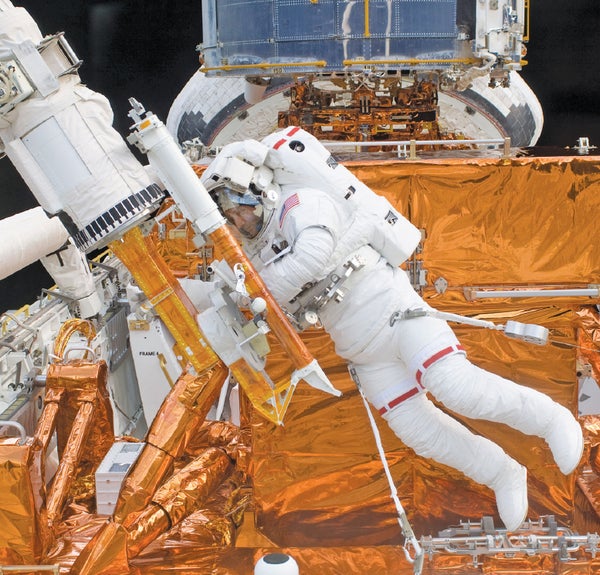
The first astronaut to tweet from space was once a skinny kid from Long Island who dreamed of going into orbit. In his memoir, Massimino tells of how he ended up on the space shuttle 350 miles above Earth by way of getting a Ph.D. in mechanical engineering, passing nasa's rigorous astronaut selection process and then being assigned to two Hubble Space Telescope repair missions—one of which provided the opportunity for his first trailblazing tweet. He shares the trials and joys of his time with nasa before his retirement in 2014; his insider's account of how the nasa community mourned following the 2003 Columbia shuttle disaster is particularly vivid. Massimino's narrative of becoming an astronaut is anchored by his honesty about his fear of failure and by his obvious affection for his fellow astronauts. —Karl J. P. Smith
Cat Wars: The Devastating Consequences of a Cuddly Killer
by Peter P. Marra and Chris Santella.
Princeton University Press, 2016 ($24.95)
On supporting science journalism
If you're enjoying this article, consider supporting our award-winning journalism by subscribing. By purchasing a subscription you are helping to ensure the future of impactful stories about the discoveries and ideas shaping our world today.
Outdoor cats kill roughly 2.4 billion birds a year in the U.S. alone, plus an additional 12.3 billion mammals and hundreds of millions of reptiles and amphibians. They are one of the greatest threats to wildlife in the country and are responsible for the extinction and decline of numerous bird species. Yet well-meaning cat lovers have consistently denied the evidence of cats' misdeeds and resisted efforts to combat the problem. For instance, they often advocate a process called “trap, neuter, return”—trapping feral cats, neutering and spaying them and then returning them to the wild—as a way to reduce the numbers of feral cats over the long term, even though studies have shown that the strategy can actually boost populations in feral colonies by drawing in unneutered animals. Marra, director of the Smithsonian Migratory Bird Center, and writer Santella make an impassioned plea for action in this compelling report on an often overlooked threat.
The War on Science: Who’s Waging It, Why It Matters, What We Can Do about It
by Shawn Otto.
Milkweed Editions, 2016 ($20)
Writer Otto marshals an astonishingly broad range of facts, trends and history to make the case that “scientific advances in public health, biology and the environment are being resisted or rolled back.” He examines the cultural and intellectual roots of current antiscience attitudes and concludes that a decades-long assault on science threatens democracy and civic progress in the U.S. and around the world. At times, Otto seems to be criticizing everyone—he eviscerates the ultraliberal antivaccine element and the “brutal, blame-the-victim aspect of New Age thinking.” He reserves his greatest ire, however, for the “antiscience of those on the right—a coalition of fundamentalist churches and corporations largely in the resource extraction, petrochemical and agrochemical industries” that fight against evidence-based policy to protect destructive business models. —Christine Gorman
Why the Wheel Is Round: Muscles, Technology, and How We Make Things Move
by Steven Vogel.
University of Chicago Press, 2016 ($35)
If the wheel were square or oval or octagonal, it would never have become the most important technological innovation in human history—the device that makes possible not only efficient transportation but also gears, pulleys, motors and capstans (look them up). Vogel, who was an expert in both biomechanics and the history of technology, explains how it all unfolded, from the rolling logs that let our distant ancestors move heavy objects to such disparate inventions as the potter's wheel, the hurdy-gurdy and the yo-yo (the ancient Greeks played with them—who knew?). Vogel also answers the key question you never thought to ask: Although wheels can rotate indefinitely, our arms and legs, which operated the earliest wheeled machines, cannot, so how did our forebears bridge the gap? Read this truly engaging book to find out. —Michael Lemonick
