
The first autonomous logging machine rumbled down a Swedish forest path and scanned for stacked logs to transport. It then scooped them up with a crane and loaded them onto its trailer. A new study of the truck-size robot, called a forwarder, suggests it could help forest workers with at least some deadly jobs.
“It’s the first trial for us to see that the machine we built is perhaps capable of doing what we were dreaming it could do,” says Pedro La Hera, a roboticist at the Swedish University of Agricultural Sciences and lead author of the study, published in the Journal of Field Robotics.
Logging jobs are often demanding, requiring operators to multitask and endure nearly constant vibration while operating logging vehicles. Fatigued foresters don’t always pay attention to other foliage in the area, the researchers say, and can damage the ecosystems around them. Logging is also dangerous; in the U.S., it has one of the highest fatality rates of any industry.
On supporting science journalism
If you're enjoying this article, consider supporting our award-winning journalism by subscribing. By purchasing a subscription you are helping to ensure the future of impactful stories about the discoveries and ideas shaping our world today.
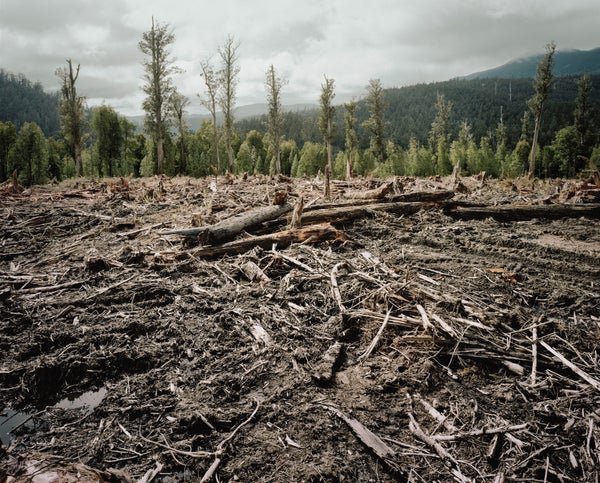
Roboticists, software engineers and forestry scholars in Sweden set out to automate some onerous logging tasks. They used GPS to set a path in a clear-cut area and equipped the vehicle with a computer vision system to help it identify, pick up and release cut logs. The predetermined task sequence demonstrates how, in a controlled environment, a machine with little to no human oversight could operate.
“It’s definitely an advancement,” says Thomas Douglass, a logger who owns Thomas Logging and Forestry in Guilford, Maine. “I, along with other contractors in this area, have problems getting help working in the woods, so I can see why at least making the forwarder an automated process would be helpful.”
For now these vehicles’ use may be limited to Sweden, where nearly all forests are managed for commercial logging, paths are well identified, and satellites provide information on logged areas. Loggers in the U.S., in contrast, harvest trees both in plantations and in natural stands where self-piloted machinery would face more challenges.
Still, the research highlights aspects of autonomous machinery that are worth developing further, says Dalia Abbas, a forester who has investigated the effects of logging operations in environmentally sensitive areas. Eventually, Abbas says, she “would definitely hope that it takes into account the fuller range of where it’s operating, whether it includes wildlife, other contaminants or bugs that come with the logs to avoid any infestations, and its sensitivity to the terrain.”
Since the experiments took place, engineers have already improved the machine’s maneuvering capabilities. The researchers are also pursuing other autonomous efforts such as planting seedlings. Although logging may always need human oversight, automating certain steps could make the process safer and more efficient, benefiting both workers and the environment, La Hera says.