
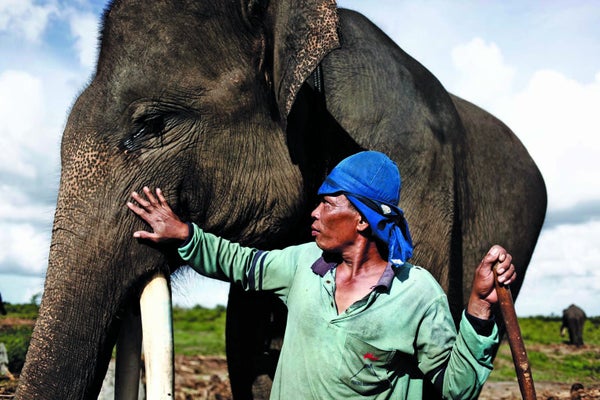
Giants of the Monsoon Forest: Living and Working with Elephants
by Jacob Shell.
W. W. Norton, 2019 ($26.95)
Asian elephants go where roads cannot. Their talent for navigating difficult terrain, coupled with their strength and smarts, has led humans to seek them out as cavalry and work animals for centuries. In rich detail, geographer Shell recounts this history and describes all the ways pachyderms collaborate with humans—for example, as draught animals for logging companies along the Indian-Burmese border and with Kachin Independence Army fighters, who run the world's only existing bureaucratically administered elephant-based transportation network. Shell meets Indian mahouts—or elephant keepers—and the animals themselves, which have unique personalities and striking intelligence. Ultimately Asian elephants' numbers are declining, primarily as a result of human activity—through either poaching or habitat destruction. Shell calls for a conservation strategy that involves the very people who engage with the creatures in the remote forests they call home. —Jim Daley
Cribsheet: A Data-Driven Guide to Better, More Relaxed Parenting, from Birth to Preschool
by Emily Oster.
Penguin Press, 2019 ($28)
On supporting science journalism
If you're enjoying this article, consider supporting our award-winning journalism by subscribing. By purchasing a subscription you are helping to ensure the future of impactful stories about the discoveries and ideas shaping our world today.
To swaddle or not to swaddle? Just one of the questions that comes up for parents of small children. Amid thousands of tomes, few offer such data-driven advice with so little agenda. Economist Oster evaluates the research on such hot-button issues as nursing, baby sleep and feeding to help parents make evidence-based decisions. For instance, breastfeeding is beneficial but perhaps less so than many claim; letting infants cry it out will not cause long-term damage; and there are good reasons to choose a nanny or day care, depending on your situation. Oster aims to “take some of the stress out of the early years by arming you with good information and a method for making the best decisions for your family.” —Clara Moskowitz
The Universe Speaks in Numbers: How Modern Math Reveals Nature's Deepest Secrets
by Graham Farmelo.
Basic Books, 2019 ($30)
Mathematics supplies invaluable clues to our understanding of the universe. Likewise, physics discoveries have often revealed new concepts in math. Yet not all physicists agree about how central math should be—some prefer the less abstract method of experiment and observation. Physicist Farmelo argues for placing math at the forefront, citing a legacy that goes back to Newton. For example, Einstein realized he needed to embrace advanced differential geometry to work on 4-D spacetime. And Emmy Noether discovered a connection that linked mathematical descriptions of nature and experimental results. Farmelo shows that theoretical physics and pure mathematics thrive best together. —Sunya Bhutta
Underland: A Deep Time Journey
by Robert Macfarlane.
W. W. Norton, 2019 ($27.95)
Learning is often symbolized by light and height—a bulb switching on, a bird's-eye view or a flashlight carving away shadow. Writer Macfarlane takes the opposite tack, searching for answers in the deep and the dark. In this visceral, haunting travelogue through caves and catacombs and into glaciers and underground rivers across Europe and the Arctic, the author illustrates how humans have long relied on the underworld “to shelter what is precious, to yield what is valuable, and to dispose of what is harmful.” From burial rituals and ghost cities to deep-sea oil rigs and tombs for nuclear waste, Macfarlane explores how societies have been molded by the subterranean landscapes on which they are built—and how humans are poised to stamp an unprecedented legacy deep into the earth's geologic memory. —Frankie Schembri
