
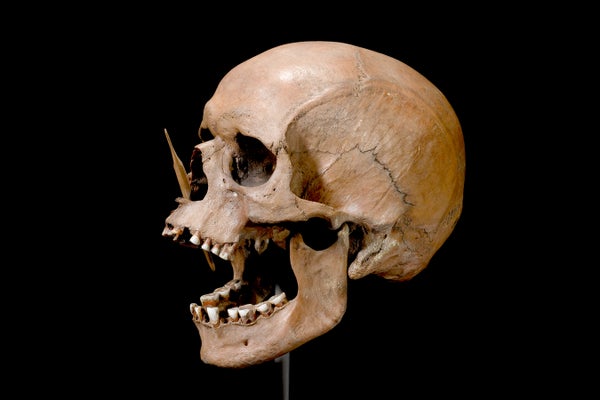
More than 1,600 ancient genomes have helped to trace the roots of a host of genetic traits found in modern Europeans. The genomes suggest that many characteristics — including a heightened risk for multiple sclerosis — were carried to Europe by people who migrated to the continent in three distinct waves starting around 45,000 years ago.
These results and others were published today in four related papers in Nature.
The findings provide evidence that some of the regional variation in certain traits was caused by differences in migrants’ dispersal patterns. That contradicts the idea that genetic differences arose mainly as people adapted to conditions in specific locations in Europe.
On supporting science journalism
If you're enjoying this article, consider supporting our award-winning journalism by subscribing. By purchasing a subscription you are helping to ensure the future of impactful stories about the discoveries and ideas shaping our world today.
“This is a tour de force,” says Lluís Quintana-Murci, a population geneticist at the Pasteur Institute in Paris who was not involved in the study. He says that the research provides unprecedented detail on how ancient ancestry can influence disease risk to this day. “It’s a beautiful example of how, by addressing very basic fundamental anthropological and genomic questions, you can inform medicine,” he says.
New arrivals
Europe was settled by anatomically modern humans in three main waves: hunter-gatherers reached Europe from Asia around 45,000 years ago; farmers arrived from the Middle East 11,000 years ago; and pastoralists — animal herders — came from the steppes of western Asia and eastern Europe 5,000 years ago. Archaeologists and historians had assumed that these groups mixed with one another throughout the continent, and that populations in particular places evolved distinct traits in response to their local environments.
But when geneticist Eske Willerslev at the University of Cambridge, UK, and his team began investigating the ancient-human genomes, they found that that wasn’t the full story. The researchers collected and sequenced DNA from 317 ancient skeletons found in Europe, most of which were between 3,000 and 11,000 years old. They then combined these sequences with existing genomic data from more than 1,300 other ancient Eurasians.
By comparing the remains’ genetic markers, ages and burial locations, the scientists were able to draw a European family tree and migration map that revealed how genomic characteristics in a specific location changed as populations moved over time1. It showed, for instance, that the steppe pastoralists mainly went to the more northern parts of Europe, whereas the Middle Eastern farmers went to the south and west.
Some of these migrants completely replaced existing populations. Denmark, for instance, underwent two large population transitions, each within just a few generations. Willerslev says that archaeological evidence and the speed of the transition suggest that the newcomers killed all the locals rather than driving them out or mixing with them.
Of genes and geography
The dispersal patterns mean that many modern Europeans carry some genetic ancestry from all three population waves, but the relative amount of each varies depending on the location, Willerslev says.
Next, the researchers compared the ancient genomes with those of 410,000 modern individuals whose genetic profiles are stored in the UK Biobank, a massive database of genetic and physical information. The data provided clear evidence that many traits trace back directly to one of the three migration waves.
For instance, modern northern Europeans are taller and lighter skinned than their southern counterparts because they have more ancestry from the steppe pastoralists. And those with the most hunter-gatherer ancestry, commonly found in northeastern Europe, have variants that put them at higher risk of diabetes and Alzheimer’s disease.
“A lot of the history was created outside Europe,” Willerslev says. But once these migrants settled in geographically isolated areas of Europe, these variants became cemented in individual populations.
The study helped to solve questions such as why human adults evolved the ability to digest milk before Europeans herded animals. Mutations near the gene encoding lactase, the enzyme that allows babies to process milk, could have helped early humans to survive famines even before the arrival of the pastoralists. These mutations might have primed the genome for development of the variant that allows lactase to continue to function in adults.
But it’s unclear whether other traits, such as height, provided any advantage to the people who carried them, Willerslev says.
Evolutionary mysteries
That ambiguity does not surprise Tony Capra, an evolutionary geneticist at the University of California, San Francisco. “It’s just really, really hard to know what drives selection,” he says. Although it can be tempting to conclude that a genetic variant was an evolutionary adaptation to an environment, sometimes it is just the result of who was living there at the time, Capra notes. “Even with these amazing windows into the past that ancient DNA gives us, it just underscores what a complex process human evolution has been.”
Surprisingly, one of the traits that seems to have had a strong evolutionary advantage is one associated with a predisposition to multiple sclerosis. This trait arrived in Europe with the west-Asian pastoralists and became even more common in northern Europe over the subsequent millennia.
Today, multiple sclerosis is a devastating disease caused by an overactive immune system attacking the nervous system. But that superpowered immune system, or genetic variants associated with it, could have helped ancient people to survive plagues and common pathogens, Willerslev says. “That’s the best explanation we can come up with.”
Capra says that the team has taken a “clever” approach to understanding ancient humans by looking at how ancestry affects modern traits, rather than trying to figure out the traits by looking only at ancient-DNA samples. The next step, he and Quintana-Murci say, will be for researchers to apply the methods developed by Willerslev and his colleagues to genomes from other parts of the world, such as southeast Asia and the Americas.
This article is reproduced with permission and was first published on January 10, 2024.