
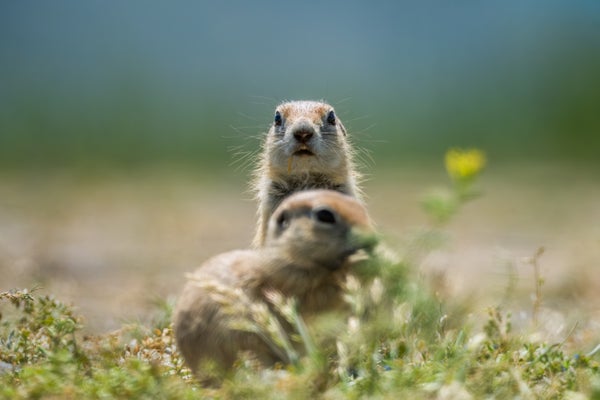
Ground squirrels spend many months in a winter slumber, and then awake ravenous and eat anything and everything in sight. A study of 700,000-year-old DNA from coprolites — fossilized poo — has now revealed that when ancient relatives of ground squirrels (Urocitellus sp.) woke up, they ate a diverse diet of plants, insects and carcasses of megafauna, including woolly mammoths, bison and big cats.
The DNA sequences, reported in a 9 June Nature Communications study, reveal a previously unknown lineage of ground squirrel and, potentially, North America’s oldest mammoth DNA.
There are 13 species of ground squirrel in the genus Urocitellus, and they are found mostly in northwestern North America and Asia. Ground squirrels are named for their earthen burrows, where they can spend up to eight months of the year in a hibernation-like state called torpor.
On supporting science journalism
If you're enjoying this article, consider supporting our award-winning journalism by subscribing. By purchasing a subscription you are helping to ensure the future of impactful stories about the discoveries and ideas shaping our world today.
When they emerge, “they’re desperate for protein and high-quality diet items”, says Bryan McLean, an evolutionary biologist at the University of North Carolina at Greensboro. “I’ve seen them eating roadkill individuals of the same species.”
In the Klondike region of Canada’s Yukon territory, gold-mining practices that dissolve permafrost deposits using jets of water have also uncovered ancient ground-squirrel burrows filled with coprolites.
Tyler Murchie, a biomolecular archaeologist at the Hakai Institute in Heriot Bay, Canada, and his colleagues wondered whether the coprolites would serve as a genetic archive of past ecosystems — through the lens of ground-squirrel diets.
The coprolites were dated to between around 700,000 and 17,000 years old, during a geological period, known as the Pleistocene, that was punctuated by ice ages, and when mammoths, bison, horse and other megafauna roamed North America.
Still, Murchie was initially amazed when mitochondrial-DNA sequences from this ‘ice-age cast’ turned up in the coprolites — as did sequences from rodents, bats and birds; invertebrates, including parasitic worms; and plants such as grasses and sedges. Big-cat DNA belonged to either the North American cheetah (Miracinonyx trumani), Murchie suspects, or to pumas (Puma concolor).
“You can imagine these squirrels emerging from the ground, starting to eat carcasses lying in the environment,” says Mikkel Pedersen, a molecular palaeoecologist at the University of Copenhagen. “They’re zombies of the Pleistocene.”
The authors dated the oldest coprolites using volcanic-ash deposits found directly on top of the samples. If those age estimates are accurate, the DNA sequences of mammoths and other 700,000-year-samples would be among the oldest on record for any organisms, says Pedersen, who peer-reviewed the manuscript. “Most evidence points to the fact that these are a set of coprolites that could be 700,000 years old,” Pedersen says.
The ancient DNA — including around 20 complete mitochondrial genomes — revealed some big surprises. Ice-age squirrel remains that were initially identified as Arctic ground squirrels (Urocitellus parryii) — similar to those found in the Yukon today — instead belonged to a previously unknown lineage of the long-tailed ground squirrel Urocitellus undulatus, a species now found in Siberia, Mongolia, China and Kazakhstan.
Murchie says that a forthcoming, unpublished paper, focused on mammoth sequences, will reveal further intrigue. He hopes other ancient-DNA researchers will see ground-squirrel poo as an untapped palaeo-archive that can be used alongside more conventional resources such as bones and sediment. McLean says he would love to get DNA from ground-squirrel poo found at lower latitudes, and not just in permafrost. “We need some coprolites in other parts of the range as well.”
This article is reproduced with permission and was first published on June 9, 2026.