
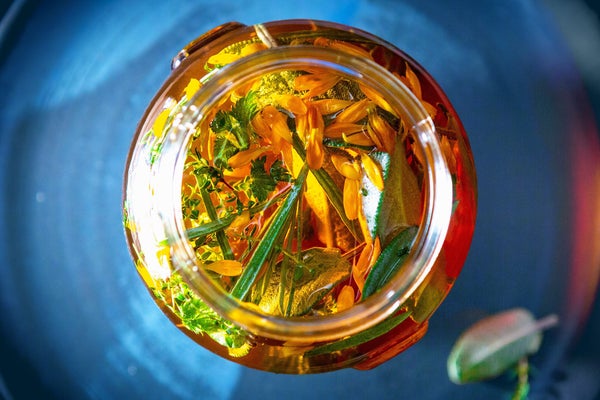
Honey and vinegar, a traditional medicinal combination known as oxymel, dates to the ancient world. Apothecaries in the Middle Ages sold it, Hippocrates prescribed it and the physician-philosopher Ibn-Sīnā extolled its virtues. Today such a mixture sounds likelier to dress a salad than a lesion—but with antibiotic-resistant bacteria on the rise, scientists are eagerly seeking new ways to fight intransigent infections. Now a study in Microbiology suggests oxymel may indeed help.
“In modern medicine both honey and acetic acid are used individually to treat infected wounds,” but they are typically not combined, says study co-author Erin Connelly, an interdisciplinary researcher at the University of Warwick in England, who studies the antimicrobial properties of historic remedies. Honey stresses bacteria and fights infections with its high sugar content and acidity. Similarly, vinegar's active component, acetic acid, is a natural antiseptic that breaks down bacterial DNA and proteins.
Neither compound is particularly effective alone, Connelly and her team found. The researchers applied low doses of honey and acetic acid separately to laboratory-grown formations called biofilms, made up of the common wound pathogens Pseudomonas aeruginosa and Staphylococcus aureus. Most of the bacteria lived. “But when we put these low doses together, we saw a large number of bacteria dying, which is really exciting,” says study co-author Freya Harrison, who studies chronic infections at the University of Warwick. Oxymel killed up to 1,000 times more bacteria in the biofilm than vinegar alone and up to 100,000 times more than honey alone.
On supporting science journalism
If you're enjoying this article, consider supporting our award-winning journalism by subscribing. By purchasing a subscription you are helping to ensure the future of impactful stories about the discoveries and ideas shaping our world today.
Oxymel could be particularly valuable for chronic wound infections, the researchers say. These long-lived skin lesions are common in people with diabetes or burn trauma, and they often contain organized colonies of stubbornly antibiotic-resistant bacteria. It is estimated that 1 to 2 percent of the population in developed countries will experience a chronic wound during their lifetime, and the rate appears to be increasing as diabetes becomes more common.
“Chronic wounds are a huge burden on the health-care system,” says Andrew Vardanian, a plastic surgeon at UCLA Health, who specializes in complex wounds. “We need alternatives because some treatments don't work for certain patients.” Additionally, long-term antibiotic use on a stubborn infection can make the bacteria more drug-resistant. Oxymel would also be much cheaper than existing infection treatments, Vardanian explains.
Next the researchers plan to investigate why the combination of honey and vinegar works better than either alone, which remains a mystery for now. If oxymel proves successful in treating humans, this inexpensive old remedy would be an important addition to the arsenal for fighting resistant infections.