
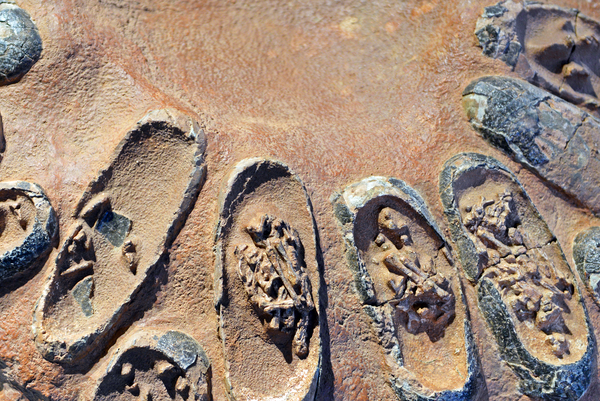
An exquisitely preserved dinosaur nesting site discovered in the Gobi Desert shows that some of these prehistoric animals nested in groups and, like birds, protected their eggs.
“Dinosaurs are often portrayed as solitary creatures that nested on their own, buried their eggs and then just went away,” says François Therrien, a palaeontologist at the Royal Tyrrell Museum of Palaeontology near Calgary, Canada. He co-authored a study published this month in Geology describing the find. “But here we show that some dinosaurs were much more gregarious. They came together and established a colony that they likely protected,” Therrien says.
The find includes the fossils of 15 nests and more than 50 eggs that are roughly 80 million years old. It provides the clearest evidence to date that complex reproductive behaviours, such as group nesting, evolved before modern birds split off from the dinosaurs 66 million years ago.
On supporting science journalism
If you're enjoying this article, consider supporting our award-winning journalism by subscribing. By purchasing a subscription you are helping to ensure the future of impactful stories about the discoveries and ideas shaping our world today.
Certain modern birds and crocodiles build nests and lay eggs in a communal area during their breeding seasons. Many palaeontologists think that this ‘colonial nesting’ first arose in dinosaurs, as a way to counter nest predators. But the evidence for this hasn’t been solid, says Amy Balanoff, a palaeontologist at Johns Hopkins University in Baltimore, Maryland.
Since the 1980s, palaeontologists have unearthed fossilized eggs or nests that are clustered together. But the surrounding rock often represents several thousand years or more, making it difficult for researchers to tell whether the eggs were laid at the same time, or just in the same place years apart, says Darla Zelenitsky, a palaeontologist at Calgary University in Canada and a study co-author.
A thin red line
The recently-described nest site is different. Located in southeast Mongolia, the 286-square-metre formation contains vivid layers of orange and grey. Between these bands runs a thin streak of bright red rock that connects 15 clutches of relatively undisturbed eggs. Some of the spherical eggs, about 10–15 centimetres in diameter, had hatched and were partially filled with the red rock.
Flooding from a nearby river, which blanketed the nesting site under a thin veneer of sediment, probably created that bright red line, says Therrien. “Because everything is relatively undisturbed, it likely wasn’t a massive flood,” he says.
But the streak connects all of the eggs, suggesting the dinosaurs laid them in a single breeding season. “Geologically, I don’t think we could’ve asked for a better site,” says Zelenitsky.
“It’s a compelling story,” says Balanoff, adding that the researchers back it up with a strong analysis.
Zelenitsky and her colleagues were also able to identify the type of dinosaurs that were probably responsible. The eggs’ exterior and interior textures, as well as shell thickness, points to a kind of non-avian theropod, a large group that includes dinosaurs such as velociraptors and Tyrannosaurus.
The researchers also estimated that just over half of the nests had at least one successful hatch, on account of the number of fragmented eggs. This relatively high rate mirrors the hatching success of modern birds and crocodiles that guard their nests, rather than those that abandon or only occasionally check their nests.
“Sometimes you can extract a fascinating and detailed story about the ecology and behaviour of these animals simply by looking at the rocks themselves,” Therrien says.
Daniel Barta, a palaeontologist at California State University, Los Angeles, agrees that such a high rate suggests that some dinosaurs tended to their nests. But he cautions that eggs that have hatched and those that predators have cracked open can often look similar.
This article is reproduced with permission and was first published on July 15, 2019.