
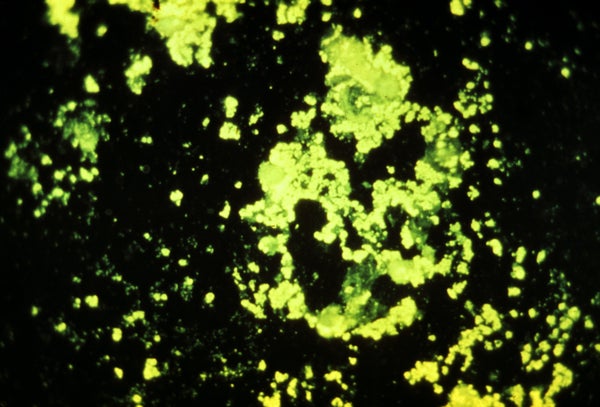
Nearly 4,000 years ago, a woman and a man were buried together just east of the Volga River in modern-day Russia, with a secret locked away in the pulp of their teeth.
The bodies were uncovered just a few years ago, the teeth pulled and sent westward to the Max Planck Institute in Germany, where Maria Spyrou was working on a Ph.D. in paleogenetics. When she subjected the pulp to a bevy of genetic tests, she found something surprising: an ancestor of the bacteria responsible for the Black Death.
She published that finding Friday in Nature Communications, providing evidence that the bacteria has origins at least 800 years earlier than scientists had previously thought.
On supporting science journalism
If you're enjoying this article, consider supporting our award-winning journalism by subscribing. By purchasing a subscription you are helping to ensure the future of impactful stories about the discoveries and ideas shaping our world today.
Spyrou’s finding gets at a larger scientific question, with implications for infectious diseases beyond plague: Where do diseases come from in the first place?
“Understanding how a disease emerges is something we don’t really know,” Spyrou said. “Of course, every disease has a different way, or might have a different way, [but] there are patterns there that might help us understand it in more global terms, perhaps.”
This could have implications for fighting infectious diseases—also for better understanding human history itself, she said.
The first known plague pandemic began in the mid-500s, well before the Black Death of the 14th century. The fact that plague-causing bacteria were circulating for thousands of years before that initial pandemic raises the question of whether there were other devastating outbreaks that historians have yet to uncover.
“Understanding the natural history of such diseases is really key to understanding our history,” Spyrou said.
The plague-causing Yersinia pestis bacteria lives in rodents. Fleas bite those rodents, and then bite humans, transmitting the bacteria.
Prior to the publication of this paper, scientists thought that the variety of Yersinia pestis that caused the Black Plague emerged around 1,000 BCE. That was the conclusion of a 2015 research paper by a different team.
But, according to that paper and a 2017 paper that Spyrou worked on, there were other varieties of plague-causing bacteria circulating millennia ago.
The previously discovered strains of bacteria were “not efficiently transmitted by the flea,” though, Spyrou said. They lacked key genetic characteristics, which were present in the bacteria that caused the Black Death.
The bacteria that Spyrou reported in her Friday paper, dating to about 3,800 years ago, do have such genetic characteristics, meaning plague-causing bacteria may have been growing in flea guts—and infecting humans—earlier than previously thought.
Francois Balloux, a professor at University College London who directs the UCL Genetics Institute, said that Spyrou’s research was well-conducted from a technical perspective, and that it was “cool,” though “a bit incremental.”
And plague is not just a historical phenomenon. The disease still exists today, from Madagascar to Mongolia to Arizona.
Spyrou said that studying plague across these different parts of the world might be the key to finding the origin of the disease. She recommends focusing on central Asia.
Republished with permission from STAT. This article originally appeared on June 8, 2018