
Researchers have partially deciphered the "unknown Kushan script" — a writing system that has puzzled linguists since it was first found in the 1950s.
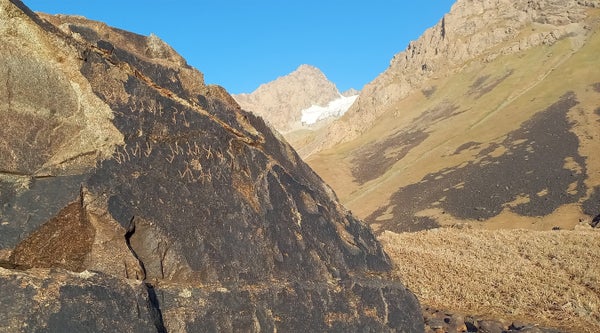
The researchers decoded the ancient text using rock face inscriptions that were discovered near the Almosi Gorge in northwest Tajikistan in 2022, which include sections in an extinct but known language called Bactrian.
"We have worked out that the so-called 'Kushan script' was used to record a previously unknown Middle Iranian language," lead study author Svenja Bonmann, a comparative linguist at the University of Cologne in Germany, said in a video posted by the university on July 13. "In other words, we have deciphered the script."
On supporting science journalism
If you're enjoying this article, consider supporting our award-winning journalism by subscribing. By purchasing a subscription you are helping to ensure the future of impactful stories about the discoveries and ideas shaping our world today.
This Middle Iranian language was likely one of the official languages of the Kushan Empire, which sprawled across Central Asia and northwestern India between 200 B.C. and A.D. 700. At the height of its power, in the second century A.D., the Kushans co-existed with the Roman Empire. Ancient Eurasian nomads that originally settled in the Kushan Empire — called the "Tocharians" by Greco Roman authors — may also have spoken the language, which the researchers have proposed to call "Eteo-Tocharian." ("Eteo" is a prefix used by modern scholars that means "true" or "original.")

A close-up of the Bactrian and Kushan inscriptions on the rock face. Credit: Bobomullo Bobomulloev
The script associated with this Kushan language has remained elusive partly because many texts didn't withstand the test of time, Bonmann said. "Most of what was written at the time was probably recorded on organic materials, such as palm-tree leaves or the bark of birch trees. Organic material decomposes very quickly, which means practically none of it remains."
Characters carved into cave walls and painted onto ceramics, however, have survived across Central Asia and provide clues about the Kushan language. Archeologists have discovered several dozen inscriptions since the late 1950s, mostly in present-day Tajikistan, Afghanistan and Uzbekistan.
"Researchers have worked on this for decades, mostly in France and Russia, but they were met with little success," Eugen Hill, a professor of comparative linguistics at the University of Cologne who did not participate in the study, said in the video.
An Iranian language
In a study published July 12 in the journal Transactions of the Philological Society, Bonmann and her colleagues examined the newly discovered "bilingual" inscriptions and decoded the Kushan script using similar methods to those previously used to decipher other ancient languages.
"The best-case scenario is to have a parallel text — a so-called bilingual or trilingual — that presents approximately the same meaning, but in two or three different scripts or languages," Bonmann said.
In this case, the researchers were able to work out the Kushan meaning using parallel inscriptions in Bactrian carved into rocks found at Almosi Gorge and at Dašt-i Nāwur, in Afghanistan, in the 1960s.
"We had parallel texts and we knew that the elements they contained were likely to come up in our script," Bonmann said. "Step by step, we were able to read more and more Iranian words, so it became clear that this was an Iranian language."
Words that referred to Kushan emperor Vema Takhtu as the "king of kings" in the texts from Tajikistan and Afghanistan tipped the researchers off about the phonetic values of individual characters that had, until then, remained a mystery. Their observations suggest the Kushan script records a language that developed mid-way between Bactrian and a language known as Khotanese Saka that was spoken in ancient western China.
The discovery sheds light on more than half of the 25 to 30 signs used in the Kushan script, according to the study. The team hopes that by re-examining known inscriptions and searching for more examples, they can decipher the remaining characters and read the enigmatic script in its entirety.
Copyright 2023 LiveScience, a Future company. All rights reserved. This material may not be published, broadcast, rewritten or redistributed.