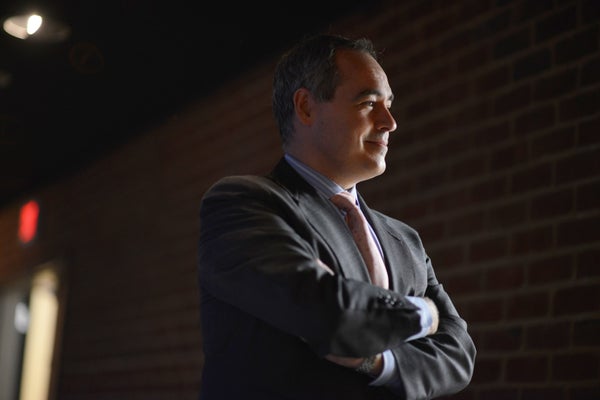
Ángel Cabrera is a Spanish American academic and higher education leader who has served as president of the Georgia Institute of Technology since 2019. He previously led George Mason University and the Thunderbird School of Global Management and was dean of Spain’s IE Business School.
[This interview was edited for length and clarity.]
How would you describe the current state of American science?
On supporting science journalism
If you're enjoying this article, consider supporting our award-winning journalism by subscribing. By purchasing a subscription you are helping to ensure the future of impactful stories about the discoveries and ideas shaping our world today.
The state is strong, but we shouldn’t take it for granted. I think we continue to lead the world. But at the same time, there’s rising skepticism—and not just in the political class but in big sections of our society—about what scientists do. I feel like we need not just be aware but truly responsive to some of the sources of mistrust if we’re going to keep that lead.
What do you think needs to change in American science?
Well, there are several things. One is we need to have a clear idea and to make a clearer case to our society of why research matters, and that doesn’t necessarily mean that we need to do applied research and not do fundamental research, but that means we need to do a better job of explaining to the average citizen why research matters. Without the trust of the public, the enterprise simply doesn’t work.
We do need to be more responsive to questions around accountability and transparency. The public needs to know how money is spent and what the public is getting from that money. So we also need to be open to funding models that incentivize efficiency, even though, I mean, there’s been a lot of political push against the current funding system. Instead of being just defensive, [we should recognize that] the current system is not perfect. So we need to be open to new funding systems that really create more accountability and more transparency, that ultimately lead the average citizen in this country to feel better that the money is well spent. Finally, I think [we must] ground our research in problems that matter to improving the human condition. And again, that doesn’t mean that all we’re going to do is apply research now. But even the basic fundamental research, I mean…, I think it’s absolutely essential that we keep asking ourselves why this work matters.
What gives you optimism right now?
Well, I mean, this has been a rough year for research in terms of cuts or threats of cuts to research, tougher conditions for visas for foreign scientists and a lot of negativity in the press about science. So if you put all this together, this should have been a catastrophe in terms of attracting new scientists. What gives me hope is that it hasn’t been. I mean, of course there’s a decline in foreign talent coming to this country, [and it’s] absolutely essential that we keep [foreign talent]. But even with all the noise and the chaos and the negativity, there is hope. We’re still attracting unbelievable people to drive the enterprise forward.
What is your best advice for an early-career scientist?
When I was a grad student, I got to spend one day with Herbert Simon..., and he had an incredibly multidisciplinary career—he [won] the Nobel prize in economics, but he is also credited for being one of the fathers of artificial intelligence and cognitive psychology and cognitive science. He’s just one of the giants. And there are a couple things that happened that day that always marked me. One, first of all, was how incredibly interesting his work was, because he bridged disciplines. I would recommend to young scientists that they don’t let themselves be siloed into a narrow field, that they look for answers elsewhere and that it is making those bridges between disciplines that leads to unbelievable breakthroughs.
The other thing is, I remember ... Simon saying, “Don’t look for the questions in the literature.” When you’re a grad student, you’re just looking at what others have done, and that’s what motivates new questions. Instead look for questions in the real world, things that can really improve the human condition, things that can make a difference. And maybe that leads you to research questions that are very fundamental and very basic, but still, be motivated by the big questions and not by whatever other scientists have done.
And then the last thing is that you should expand your networks beyond academia. Don’t restrict yourself to your academic conferences where you see the same people that you see all the time, but branch out beyond that. Organizations, businesses, policy groups, people who may be seemingly marginally related to what you do—they can really open your eyes to bigger questions.
How has your field changed in the past few years?
Well, my field when I was a grad student was cognitive psychology and cognitive science, [which tries] to understand how the human mind works. At the time, our models were rudimentary, and they didn’t work very well, and our understanding of human condition was limited. Now we have artificial intelligence changing absolutely everything that we do, changing every field of science, every business, changing our daily lives. So, in this case, AI is giving us new insights into human cognition.