
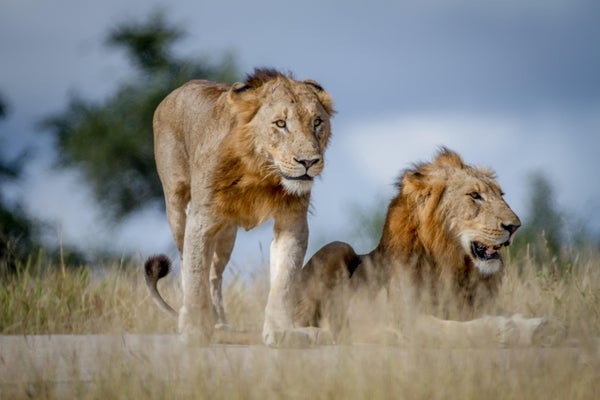
Despite heavy poaching of rhinos, South Africa’s Kruger National Park is still a natural paradise. One of the largest remaining lion populations in Africa lives there. Yet there is something the local animals fear even more than the big cats.
Liana Zanette of Western University in Ontario and her colleagues were able to show that animals react most strongly to human voices and flee in response, as the researchers report in Current Biology.
“We compared fear of humans to fear of lions to see if humans are more feared than the big cats,” says conservation biologist Michael Clinchy, a co-author of the study.
On supporting science journalism
If you're enjoying this article, consider supporting our award-winning journalism by subscribing. By purchasing a subscription you are helping to ensure the future of impactful stories about the discoveries and ideas shaping our world today.
For their experiment, the team placed camera traps and loudspeakers at water holes in the national park, which allowed the researchers to influence and record the behavior of a total of 19 mammal species. They played the animals sounds of normal conversations of humans in four South African languages, dogs barking, gunshots and lion sounds—their growls and snarls, not loud roars. “We put the camera in a bear box not because there are bears in South Africa but because of the hyenas and leopards that like to chew them up,” Zanette says. “One night, though, the lion recording made an elephant so angry that it attacked and just smashed the whole thing.”
The study group found that animals were twice as likely to flee and vacated an area faster when they heard human voices than when they heard lions or gunshots. This was true for 95 percent of the animal species observed, including giraffes, leopards, hyenas, zebras, kudu, warthogs, impalas and rhinos. Only elephants were significantly more likely to run from lions than from humans.
The same was true of the time that animals spent at water holes: they usually stayed longer when lion sounds were played to them than when human voices were heard. Wild dogs, leopards and buffalo were the only animals who stayed at water holes longer when they heard humans, and the difference was not statistically significant for these species. “There is a notion that animals get used to humans when they are not being hunted. But we’ve shown that’s not the case,” Clinchy says. “Fear of humans is deeply rooted and pervasive, so we need to seriously address it for conservation reasons.”
The team is now investigating whether its customized sound systems can be used to help endangered species, such as the southern white rhino, away from known poaching areas in South Africa. Initial tests of keeping rhinos away from such areas through the use of human voices have been successful.
This article originally appeared in Spektrum der Wissenschaft and was reproduced with permission.