
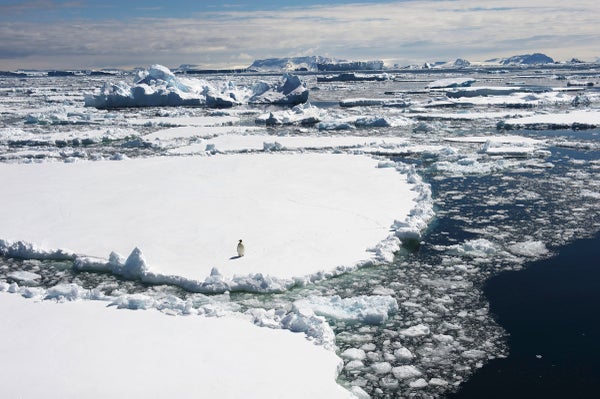
Delegates attending an international meeting meant to protect Antarctic ocean life dashed conservationists' hopes for new marine protected areas in the Southern Ocean.
The Commission for the Conservation of Antarctic Marine Living Resources (CCAMLR) concluded Friday after a week of virtual negotiations among its 26 member nations. It declined to approve three proposals for marine protected areas near Antarctica.
The commission, established in 1982 as part of the Antarctic Treaty System, is charged with conserving marine life around the southern continent and sustainably managing the region's fish stocks.
On supporting science journalism
If you're enjoying this article, consider supporting our award-winning journalism by subscribing. By purchasing a subscription you are helping to ensure the future of impactful stories about the discoveries and ideas shaping our world today.
Those responsibilities include the power to designate marine protected areas, or MPAs, around Antarctica, if all member states collectively agree. So far, there are just two in existence: one in the Ross Sea and one around the South Orkney Islands north of the Antarctic Peninsula.
This year's meeting included proposals for three additional MPAs: one off the coast of East Antarctica, one in the Weddell Sea and one around the Antarctic Peninsula. Scientists warn that a combination of climate change, fishing and other human activities around Antarctica could be disrupting the region's delicate ecosystems.
The Antarctic Peninsula in particular is a region that may be especially vulnerable to human disturbances in the coming decades, researchers say (Climatewire, Oct. 26).
For decades, the peninsula was one of the fastest-warming parts of the globe. In recent years, the warming trend has dampened, likely due in part to atmospheric changes caused by the recovery of the Antarctic ozone hole.
Still, temperatures there have already risen substantially — this year brought record-high temperatures to the peninsula — and scientists expect the region to continue heating up in the coming decades.
As the waters warm and Antarctic sea ice declines, researchers are concerned that krill populations around the peninsula could start to shrink. These tiny, shrimplike creatures form the backbone of the Antarctic ecosystem, providing food for everything from whales to penguins.
At the same time, krill fishing around the peninsula is on the rise. Some scientists have expressed concern that the combination of increased fishing and climate change could be a major threat to Antarctic marine life.
A marine protected area, according to some, could help reduce the risk of overfishing and protect vital krill populations. Earlier this month, a group of nine scientists published a comment in the journal Nature urging CCAMLR delegates to adopt the proposed Antarctic Peninsula MPA.
The meeting concluded Friday without designating any new MPAs.
All the proposed MPAs had been on the table for the past several years. Each year, they've all fallen short of the consensus needed to pass them.
That's despite a show of support from most member nations this year, according to Andrea Kavanagh, director of Antarctic and Southern Ocean conservation work at the Pew Charitable Trusts, which advocates for more Southern Ocean MPAs. Kavanagh attended the virtual proceedings last week.
The MPAs failed to gain the necessary support from Russia and China, she said, pointing to nations that have blocked proposed MPAs in the past.
But Kavanagh added that there may be hope for progress next year, which will be CCAMLR's 40th meeting, and the 60th anniversary of the Antarctic Treaty System.
"[A]lthough no MPA designations took place this year, Norway and Uruguay signed on as new co-sponsors of the East Antarctic MPA, while Australia and Uruguay did the same for the Weddell Sea MPA," Kavanagh said in an email to E&E News. "It is some progress and I hope it sets us up for an increased diplomatic outreach at the highest levels to get these done in 2021."
Reprinted from Climatewire with permission from E&E News. E&E provides daily coverage of essential energy and environmental news at www.eenews.net.