
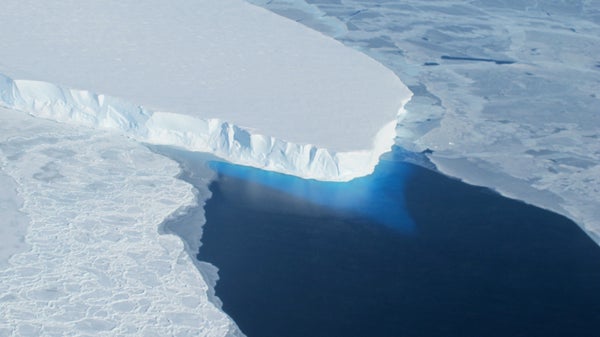
A pair of studies this week have shed new light on the melting of the Thwaites Glacier, one of Antarctica’s largest and most menacing stretches of ice. Often referred to as the “Doomsday Glacier,” it contains enough ice to raise global sea levels by about 2 feet all on its own.
The new research contains some sobering conclusions. On the one hand, Thwaites may be melting more slowly than previous estimates have suggested. On the other hand, it’s still rapidly retreating inland from the sea. That suggests it may take less melting to destabilize the glacier than scientists once thought.
“Our results are a surprise but the glacier is still in trouble,” said oceanographer Peter Davis, lead author of one of the studies, in a statement. “What we have found is that despite small amounts of melting there is still rapid glacier retreat, so it seems that it doesn’t take a lot to push the glacier out of balance.”
On supporting science journalism
If you're enjoying this article, consider supporting our award-winning journalism by subscribing. By purchasing a subscription you are helping to ensure the future of impactful stories about the discoveries and ideas shaping our world today.
The two studies, both published Wednesday in the journal Nature, report some of the latest findings from the International Thwaites Glacier Collaboration, a joint initiative of the U.S. National Science Foundation and the United Kingdom's National Environment Research Council. The project, which kicked off in 2018, explores the factors driving the giant glacier’s melting and retreat.
The two studies specifically report on findings from an initiative known as the MELT project, an effort to understand the way warm ocean waters are driving melting at the glacier’s grounding line. That’s the point where the ice attaches to the bedrock, anchoring it to the earth. Beyond the grounding line, the ice detaches from the ground and juts out in front of the glacier in the form of a floating ice shelf.
These are critically important parts of any seaside glacier. Ocean water is able to seep beneath ice shelves and lap up against the edge of the glacier at the grounding line, melting the ice from the bottom up. This process can push the glacier backward over the bedrock, causing it to retreat inland, pouring more ice into the ocean in the process.
In the worst-case scenarios, enough melting can cause the ice shelves themselves to thin and eventually disintegrate. That can destabilize the wall of ice behind the shelf, causing the glacier to rapidly retreat.
Because Thwaites contains so much ice, and such a large potential to affect global sea levels, scientists are preoccupied with understanding the processes causing it to melt and retreat.
The two studies published this week used a variety of different methods to investigate the melting taking place at Thwaites’ grounding line. One research group drilled a hole through the ice and set up a mooring equipped with special sensors just downstream of the grounding line. The other group used an autonomous underwater vehicle, known as Icefin, to collect observations.
Both studies produced a surprising finding. Much of the melting below the ice is happening more slowly than previous estimates have suggested. Although ocean temperatures are generally well above freezing in this zone, the ocean currents are slow and the water is highly stratified — it’s structured in layers of warmer and colder water resting on top of one another, which don’t easily mix together. These conditions make it harder for the warmest water to melt the ice.
The findings indicate that Thwaites is retreating with less melting than past studies have suggested. That means it may be more sensitive to small levels of melting than scientists previously thought.
But the Icefin study revealed a second surprise. While melt rates are generally slower beneath the ice shelf than expected, there are some areas where the melt rates suddenly spike.
The Icefin found that there are certain regions underneath the shelf where the ice becomes less smooth, filled with crevasses and steep terraces. In some of these rough parts of the ice, the melt rates were found to be as much as six times higher than the average melt rates observed by instruments in smoother areas.
These regions of higher melt rates could be helping to “wear down the glacier at its weakest points,” said Cornell University oceanographer Britney Schmidt, lead author of the study, in a statement. That means they also may be helping to drive the glacier’s retreat.
In a comment on the new research, also published Wednesday in Nature, ice expert Craig McConnochie cautioned that the studies focus on “just a small region of a single glacier.” Other Antarctic glaciers have their own unique features, he added, and similar studies would need to be conducted to find out what factors are driving their own melting and retreat.
But put together, the studies suggest there may be much more happening beneath the surface of the ice at Thwaites than scientists previously understood.
“These new ways of observing the glacier allow us to understand that it’s not just how much melting is happening, but how and where it is happening that matters in these very warm parts of Antarctica,” Schmidt said.
Reprinted from E&E News with permission from POLITICO, LLC. Copyright 2023. E&E News provides essential news for energy and environment professionals.