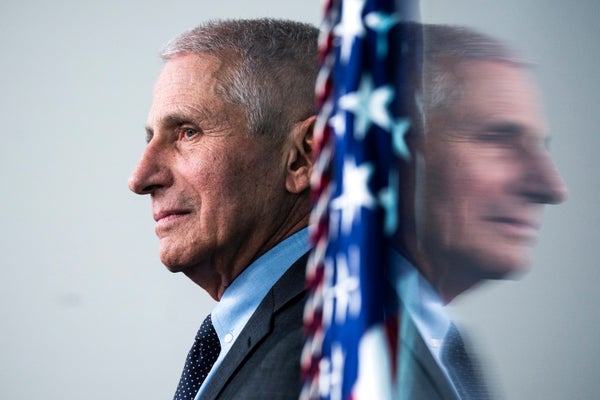
Anthony Fauci is an American physician-scientist who led the National Institute of Allergy and Infectious Diseases from 1984 to 2022 and served as a key public health adviser during multiple disease outbreaks, including HIV/AIDS, Ebola and COVID.
[This interview was edited for length and clarity.]
How would you describe the current state of American science?
On supporting science journalism
If you're enjoying this article, consider supporting our award-winning journalism by subscribing. By purchasing a subscription you are helping to ensure the future of impactful stories about the discoveries and ideas shaping our world today.
The current state of American science is generally quite good. But the recent politicization of science by current leadership at the U.S. Department of Health and Human Services and the National Institutes of Health, as well as their attempts (unsuccessful so far) to significantly reduce the allocation of resources to the NIH pose a serious threat to our standing as the leading country in the area of biomedical research.
What needs to change in American science?
Even stronger pushback is needed against attempts to downgrade the government-sponsored biomedical research efforts, including what appears to be a weakening of peer review in favor of decision-making by political appointees.
What gives you optimism right now?
I am buoyed by the brilliance and energy of our younger generation in the field of science in general and biomedical research specifically. In addition, the opportunities for major transforming advances in biomedical research are greater today than they have ever been because of technologies such as mRNA platforms, artificial-intelligence-accelerated discovery, systems immunology, engineered antibodies and immune modulators, and CRISPR and other next-generation diagnostics.
What’s your best advice for an early-career scientist?
My advice to early career scientists is to follow your passion and not be discouraged by the current stress on the system. The opportunities and sources of gratification and accomplishment that await you will be very fulfilling and rewarding. And along the way, do not forget to have some fun!
How has your field changed in the past few years?
My own field of the interface of infectious diseases and the immune system has been transformed in the past few years with technological advances that were unimaginable years ago. For example, with the help of AI, we are no longer just fighting infections—we are learning to anticipate them, model them and even design immunity against them.